Description
| SKU: | RPCB2217 |
| Size: | 10 μg, 20 μg, 50 μg, 100 μg |
| Tag: | C-hFC |
| Reactivity: | Mouse |
| Protein Description: | EPH-related receptor tyrosine kinase ligand 4 (Ephrin-A4) also known as EFNA4, is a member of the Ephrin family. The Eph family receptor interacting proteins (ephrins) are a family of proteins that serve as the ligands of the Eph receptor, which compose the largest known subfamily of receptor protein-tyrosine kinases (RTKs). Eph/ephrin interactions are implicated in axon guidance, neural crest cell migration, establishment of segmental boundaries, and formation of angiogenic capillary plexi. Ephrin subclasses are further distinguished by their mode of attachment to the plasma membrane: ephrin-A ligands bind EphA receptors and are anchored to the plasma membrane via a glycosylphosphatidylinositol (GPI) linkage, whereas ephrin-B ligands bind EphB receptors and are anchored via a transmembrane domain. Ephrin-A4/EFNA4 functions as a cell surface GPI-bound ligand for Eph receptor, a family of receptor tyrosine kinases which are crucial for migration, repulsion and adhesion during neuronal, vascular and epithelial development. |
| Endotoxin: | < 0.01 EU/μg of the protein by LAL method. |
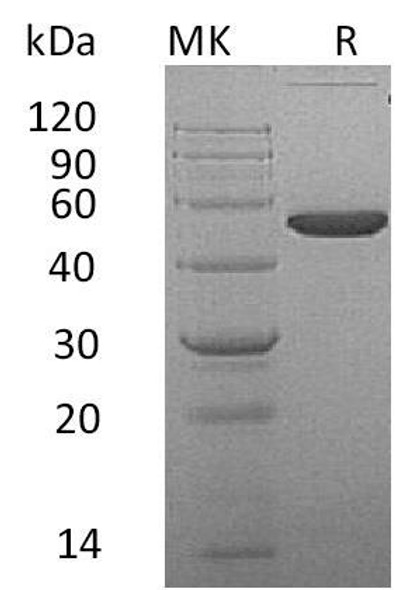
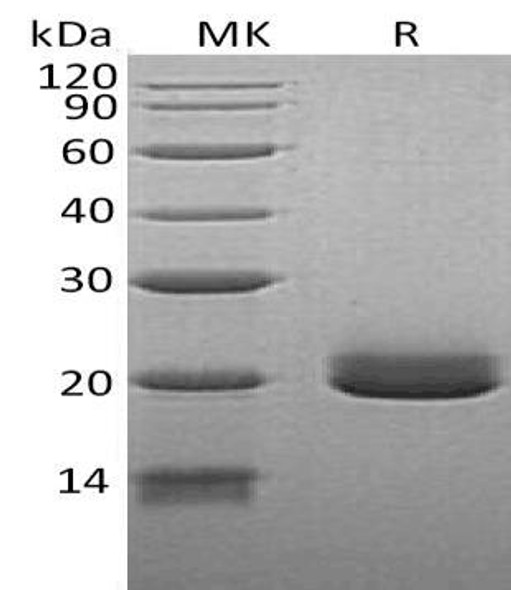
| Purity: | ≥ 90% as determined by reducing SDS-PAGE. |
| Formulation: | Lyophilized from 0.22μm filtered solution in PBS (pH 7.4). |
| Gene ID: | 13639 |
| Storage: | Store at -20℃.Store the lyophilized protein at -20℃ to -80 ℃ up to 1 year from the date of receipt. After reconstitution, the protein solution is stable at -20℃ for 3 months, at 2-8℃ for up to 1 week. |
| Reconstitution: | Centrifuge the vial before opening. Reconstitute to a concentration of 0.1-0.5 mg/mL in sterile distilled water. Avoid vortex or vigorously pipetting the protein. For long term storage, it is recommended to add a carrier protein or stablizer (e.g. 0.1% BSA, 5% HSA, 10% FBS or 5% Trehalose), and aliquot the reconstituted protein solution to minimize free-thaw cycles. |
| Swiss-Prot: | NP_031936.2 |