Description
UGT1A1 Antibody (CAB1359)
The UGT1A1 Antibody (CAB1359) is a high-quality antibody developed for reliable detection and analysis of target proteins. Raised in rabbits, this antibody is highly specific to human samples and is validated for use in Western blot applications.UGT1A1 plays a crucial role in the detoxification and elimination of potentially harmful substances from the body by conjugating them with glucuronic acid. Mutations in the UGT1A1 gene can lead to conditions like Gilbert syndrome, a disorder characterized by elevated levels of unconjugated bilirubin in the blood.
This antibody is validated for use in WB, IHC-P, IF/ICC, ELISA applications and has demonstrated reactivity against Human, Mouse, Rat samples.
| Product Name: | UGT1A1 Antibody |
| SKU: | CAB1359 |
| Size: | 20μL, 100μL |
| Reactivity: | Human, Mouse, Rat |
| Conjugate: | Unconjugated |
| Immunogen: | Recombinant protein (or fragment).This information is considered to be commercially sensitive. | ||||||||
| Sequence: | MAVE SQGG RPLV LGLL LCVL GPVV SHAG KILL IPVD GSHW LSML GAIQ QLQQ RGHE IVVL APDA SLYI RDGA FYTL KTYP VPFQ REDV KESF VSLG HNVF ENDS FLQR VIKT YKKI KKDS AMLL SGCS HLLH NKEL MASL AESS FDVM LTDP FLPC SPIV AQYL SLPT VFFL HALP CSLE FEAT QCPN PFSY VPRP LSSH | ||||||||
| Tested Applications: | WB IHC-P IF/ICC ELISA | ||||||||
| Recommended Dilution: |
| ||||||||
| Synonyms: | GNT1, UGT1, UDPGT, UGT1A, HUG-BR1, BILIQTL1, UDPGT 1-1, UGT1A1 |
| Positive Sample: | Mouse liver, Rat liver |
| Cellular Localization: | Endoplasmic Reticulum, Endoplasmic Reticulum Membrane, Microsome, Single-Pass Membrane Protein. |
| Calculated MW: | 60kDa |
| Observed MW: | 60kDa |
This gene encodes a UDP-glucuronosyltransferase, an enzyme of the glucuronidation pathway that transforms small lipophilic molecules, such as steroids, bilirubin, hormones, and drugs, into water-soluble, excretable metabolites. This gene is part of a complex locus that encodes several UDP-glucuronosyltransferases. The locus includes thirteen unique alternate first exons followed by four common exons. Four of the alternate first exons are considered pseudogenes. Each of the remaining nine 5' exons may be spliced to the four common exons, resulting in nine proteins with different N-termini and identical C-termini. Each first exon encodes the substrate binding site, and is regulated by its own promoter. The preferred substrate of this enzyme is bilirubin, although it also has moderate activity with simple phenols, flavones, and C18 steroids. Mutations in this gene result in Crigler-Najjar syndromes types I and II and in Gilbert syndrome.
| Purification Method | Affinity purification |
| Gene ID | 54658 |
| RRID | AB_2760452 |
| Buffer Information | Store at -20℃. Avoid freeze / thaw cycles. Buffer: PBS containing 50% glycerol, preserved with proclin300 or sodium azide, pH 7.3. |
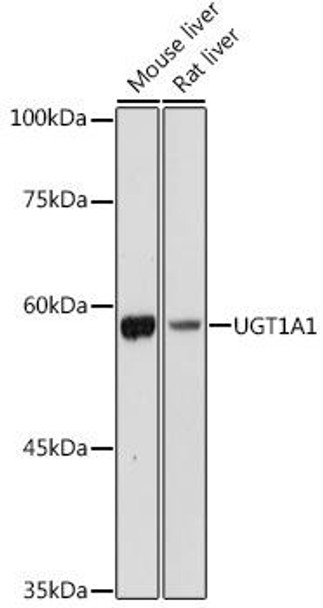
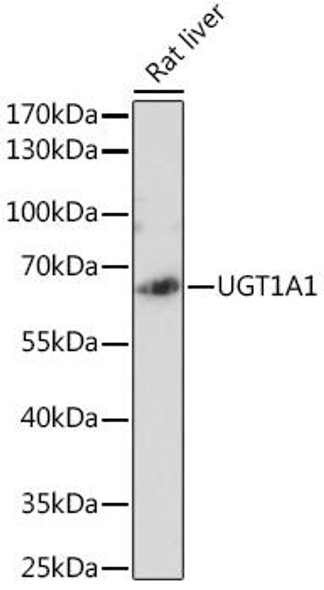
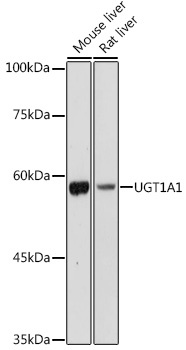 | Western blot analysis of various lysates using UGT1A1 Rabbit pAb (CAB1359) at 1:1000 dilution. Secondary antibody: HRP-conjugated Goat anti-Rabbit IgG (H+L) (CABS014) at 1:10000 dilution. Lysates/proteins: 25μg per lane. Blocking buffer: 3% nonfat dry milk in TBST. Detection: ECL Enhanced Kit (AbGn00021). Exposure time: 180s. |
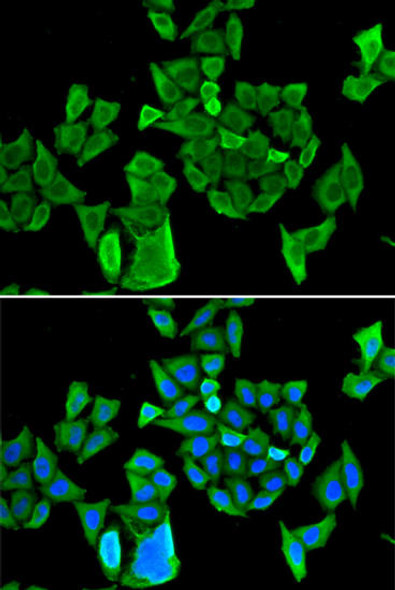
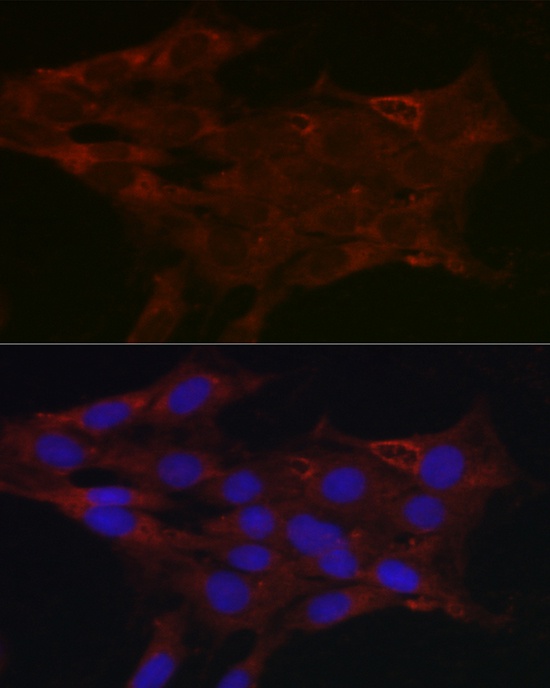 | Immunofluorescence analysis of C6 cells using UGT1A1 Rabbit pAb (CAB1359) at dilution of 1:200 (40x lens). Secondary antibody: Cy3-conjugated Goat anti-Rabbit IgG (H+L) (CABS007) at 1:500 dilution. Blue: DAPI for nuclear staining. |