The pan-Mono-MethylR (R*GG) Motif Antibody (CAB18297) is a high-quality antibody developed for reliable detection and analysis of target proteins. This antibody, raised in rabbits, is highly specific and reactive with human samples, making it ideal for use in various research applications such as immunoprecipitation and immunofluorescence.The R R GG motif is a common target for methylation, and understanding the role of mono-methylation in this motif is crucial for elucidating its function in cellular signaling pathways. The CAB18297 Antibody specifically recognizes mono-methylated R R GG motif, enabling precise detection and analysis of this modification in different cell types.
This antibody is validated for use in WB, ELISA, DB applications and has demonstrated reactivity against Human, Mouse, Rat samples.
Product Name:
pan-Mono-MethylR (R*GG) Motif Antibody
SKU:
CAB18297
Size:
20μL, 100μL
Reactivity:
Human, Mouse, Rat
Immunogen:
Synthetic peptide. This information is considered to be commercially sensitive.
Tested Applications:
WBELISADB
Recommended Dilution:
WB
1:500 - 1:1000
DB
1:500 - 1:1000
ELISA
Recommended starting concentration is 1 μg/mL. Please optimize the concentration based on your specific assay requirements.
Positive Sample:
HCT116, Mouse lung, Mouse liver, Mouse brain, Rat brain
Observed MW:
16-120kDa
Arginine methylation is a common posttranslational modification that is found on both histone and non-histone proteins. Three types of arginine methylation exist in mammalian cells: monomethylarginine (MMA), asymmetric dimethylarginine (ADMA) and symmetric dimethylarginine (SDMA). The most prevalent is omega-NG,NG-dimethylarginine. Here, two methyl groups are placed on one of the terminal nitrogen atoms of the guanidino group; this derivative is commonly referred to as asymmetric dimethylarginine (ADMA). Two other derivatives occur at levels of about 20% to 50% that of ADMA. These include the symmetric dimethylated derivative, where one methyl group is placed on each of the terminal guanidino nitrogens and the monomethylated derivative with a single methyl group on the terminal nitrogen atom . These three derivatives are present on a multitude of distinct protein species in the cytoplasm, nucleus, and organelles of mammalian cells. Methylated arginine residues in proteins are often flanked by one or more glycine residues, but there are many exceptions to this general rule.
Purification Method
Affinity purification
RRID
AB_2862070
Buffer Information
Store at -20℃. Avoid freeze / thaw cycles. Buffer: PBS with 0.01% thimerosal,50% glycerol,pH7.3.
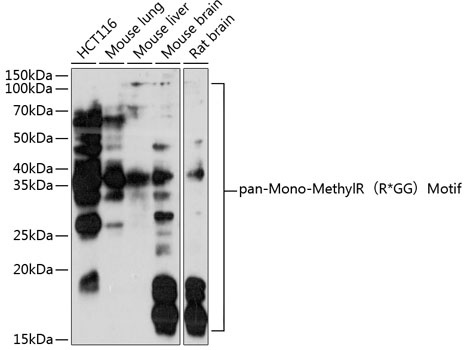
Western blot analysis of various lysates using pan-Mono-MethylR(R*GG)Motif pAb (CAB18297) at 1:1000 dilution. Secondary antibody: HRP-conjugated Goat anti-Rabbit IgG (H+L) (CABS014) at 1:10000 dilution. Lysates/proteins: 25μg per lane. Blocking buffer: 3% nonfat dry milk in TBST. Detection: ECL Basic Kit (AbGn00020). Exposure time: 90s.
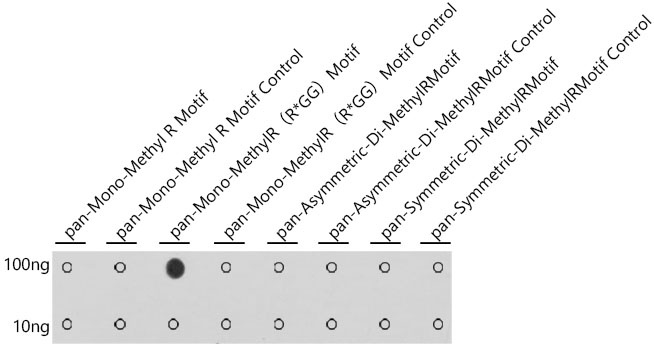
Dot-blot analysis of all sorts of peptides using pan-Mono-MethylR(R*GG)Motif Rabbit pAb (CAB18297) at 1:1000 dilution.