The BBS10 Antibody (CAB8820) is a high-quality antibody developed for reliable detection and analysis of target proteins. This antibody, produced in rabbits, demonstrates high reactivity with human samples and is validated for use in Western blot applications. By specifically binding to the BBS10 protein, this antibody enables accurate detection and analysis in a variety of cell types, making it ideal for research in genetics, developmental biology, and rare genetic disorders.BBS10 is part of a complex protein network involved in ciliary function and intraflagellar transport, making it crucial for normal development and sensory perception.
This antibody is validated for use in WB, ELISA applications and has demonstrated reactivity against Human, Mouse samples.
Product Name:
BBS10 Antibody
SKU:
CAB8820
Size:
20μL, 100μL
Reactivity:
Human, Mouse
Conjugate:
Unconjugated
Immunogen:
Recombinant protein (or fragment).This information is considered to be commercially sensitive.
Recommended starting concentration is 1 μg/mL. Please optimize the concentration based on your specific assay requirements.
Synonyms:
C12orf58, BBS10
Positive Sample:
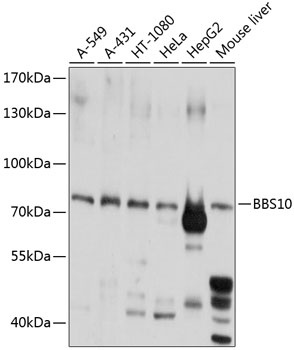
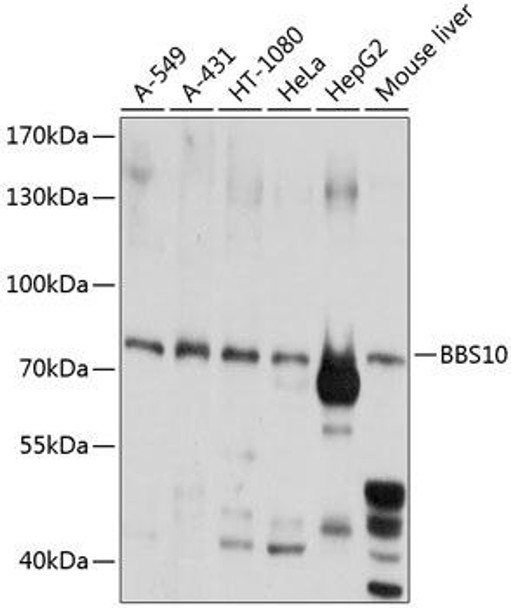
A-549, A-431, HT-1080, HeLa, HepG2, Mouse liver
Cellular Localization:
Cell Projection, Cilium.
Calculated MW:
81kDa
Observed MW:
80kDa
This gene is a member of the Bardet-Biedl syndrome (BBS) gene family. Bardet-Biedl syndrome is an autosomal recessive disorder characterized by progressive retinal degeneration, obesity, polydactyly, renal malformation and cognitive disability. The proteins encoded by BBS gene family members are structurally diverse and the similar phenotypes exhibited by mutations in BBS gene family members is likely due to their shared roles in cilia formation and function. Many BBS proteins localize to the basal bodies, ciliary axonemes, and pericentriolar regions of cells. BBS proteins may also be involved in intracellular trafficking via microtubule-related transport. The protein encoded by this gene is likely not a ciliary protein but rather has distant sequence homology to type II chaperonins. As a molecular chaperone, this protein may affect the folding or stability of other ciliary or basal body proteins. Inhibition of this protein's expression impairs ciliogenesis in preadipocytes. Mutations in this gene cause Bardet-Biedl syndrome type 10.
Purification Method
Affinity purification
Gene ID
79738
RRID
AB_2768568
Buffer Information
Store at -20℃. Avoid freeze / thaw cycles. Buffer: PBS containing 50% glycerol, preserved with proclin300 or sodium azide, pH 7.3.
Western blot analysis of various lysates using BBS10 Rabbit pAb (CAB8820) at 1:1000 dilution. Secondary antibody: HRP-conjugated Goat anti-Rabbit IgG (H+L) (CABS014) at 1:10000 dilution. Lysates/proteins: 25μg per lane. Blocking buffer: 3% nonfat dry milk in TBST. Detection: ECL Basic Kit (AbGn00020). Exposure time: 3s.