The BTBD9 Antibody (CAB18528) is a high-quality antibody developed for reliable detection and analysis of target proteins. This rabbit polyclonal antibody is highly reactive with human samples and has been validated for use in various applications, including Western blotting.BTBD9 is a BTB/POZ domain-containing protein that is involved in the regulation of ion channels in the brain, ultimately affecting neuronal excitability and muscle movement. Dysregulation of BTBD9 has been linked to restless legs syndrome, a neurological disorder characterized by an irresistible urge to move the legs, particularly at night.
This antibody is validated for use in WB, ELISA applications and has demonstrated reactivity against Human, Rat samples.
Product Name:
BTBD9 Antibody
SKU:
CAB18528
Size:
20μL, 100μL
Reactivity:
Human, Rat
Immunogen:
Recombinant protein (or fragment).This information is considered to be commercially sensitive.
Recommended starting concentration is 1 μg/mL. Please optimize the concentration based on your specific assay requirements.
Synonyms:
dJ322I12.1, BTBD9
Positive Sample:
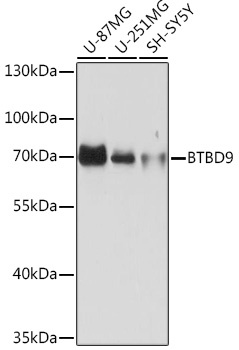
U-87MG, U-251MG, SH-SY5Y
Cellular Localization:
Cytoplasm, Glutamatergic Synapse.
Calculated MW:
69kDa
Observed MW:
70kDa
This locus encodes a BTB/POZ domain-containing protein. This domain is known to be involved in protein-protein interactions. Polymorphisms at this locus have been reported to be associated with susceptibility to Restless Legs Syndrome and may also be associated with Tourette Syndrome. Alternatively spliced transcript variants have been described.
Purification Method
Affinity purification
Gene ID
114781
RRID
AB_2862292
Buffer Information
Store at -20℃. Avoid freeze / thaw cycles. Buffer: PBS with 0.01% thimerosal,50% glycerol,pH7.3.
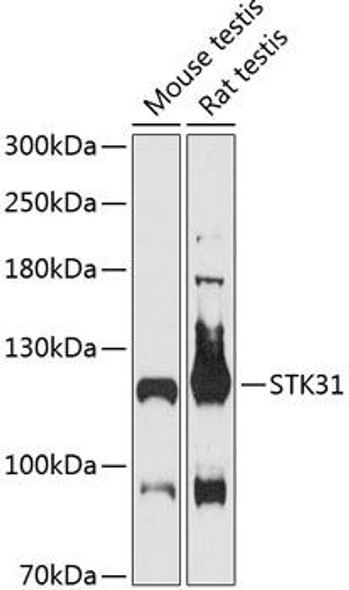
Western blot analysis of various lysates using BTBD9 Rabbit pAb (CAB18528) at 1:1000 dilution. Secondary antibody: HRP-conjugated Goat anti-Rabbit IgG (H+L) (CABS014) at 1:10000 dilution. Lysates/proteins: 25μg per lane. Blocking buffer: 3% nonfat dry milk in TBST. Detection: ECL Basic Kit (AbGn00020). Exposure time: 5s.