Description
Glycogen Assay Kit (Colorimetric/Fluorometric) (BA0065) (BA0065)
The Glycogen Assay Kit (Colorimetric/Fluorometric) (SKU: BA0065) offers a simple, direct and automation-ready method for measuring glycogen concentration. Glycogen is a branched polysaccharide of glucose units stored primarily in the liver and muscle, forming an energy reserve that can be quickly mobilised to meet a sudden need for glucose. The most common glycogen metabolism disorder is found in diabetes, while genetic glycogen storage diseases arise from deficiencies of enzymes needed for glycogen synthesis or breakdown. This assay uses a single working reagent that combines the enzymatic breakdown of glycogen and the detection of glucose in one step. The colour intensity at 570 nm, or fluorescence intensity at excitation/emission 530/585 nm, is directly proportional to the glycogen concentration. The convenient assay is carried out at room temperature and takes only 30 minutes.
| Product Name: | Glycogen Assay Kit (Colorimetric/Fluorometric) (BA0065) |
| SKU: | BA0065 |
| Detection Method: | Colorimetric or Fluorometric |
| Detection Range: | Colorimetric 2 to 200 ug/mL; fluorometric 0.2 to 20 ug/mL glycogen |
| Sample Type: | Tissue and cell samples |
| Species Reactivity: | All |
| Assay Time: | 30 minutes |
| Kit Size: | 100 Assays |
| Equipment Required: | Microplate reader |
| Storage: | -20C |
| Shelf Life: | 6 months after receipt |
| Shipping: | Gel Pack |
Quantitative colorimetric or fluorometric determination of glycogen. A single working reagent combines enzymatic breakdown of glycogen and detection of the released glucose, read at 570 nm or fluorometrically at excitation/emission 530/585 nm.
- Uses as little as 10 uL sample
- Colorimetric linear detection range 2 to 200 ug/mL glycogen
- Fluorometric linear detection range 0.2 to 20 ug/mL glycogen
- Convenient room-temperature assay completed in 30 minutes
- Glycogen determination in tissue and cell samples in research and drug discovery
Note: The below protocol is a sample protocol. Protocols are specific to each batch/lot. For the correct instructions please follow the protocol included in your kit.
| Step | Procedure |
| 1 | Reagent preparation. Reconstitute Enzyme A by adding 120 uL Assay Buffer, pipetting until fully dissolved; store reconstituted Enzyme A at -20C and use within 1 month. |
| 2 | Sample preparation. Homogenise tissue/cell sample in 25 mM citrate, pH 4.2, 2.5 g/L NaF on ice, centrifuge 14,000 g for 5 minutes and use 10 uL clear supernatant for the assay. |
| 3 | Standards and samples. Equilibrate components to room temperature. Dilute standard by mixing 5 uL Standard with 1.245 mL distilled water (200 ug/mL), prepare the dilution series shown in the table and transfer 10 uL standards and samples into separate wells of a clear plate; for samples containing glucose, transfer an additional 10 uL for a Sample Blank. |
| 4 | Working reagent. For each reaction well mix 90 uL Assay Buffer, 1 uL Enzyme A, 1 uL Enzyme B and 1 uL Dye Reagent (omit Enzyme A for Sample Blanks). Transfer 90 uL working reagent into each well and tap to mix. |
| 5 | Incubate 30 minutes at room temperature and read OD at 570 nm (550-585 nm). For fluorometric assays use 0, 5, 10, 15 and 20 ug/mL standards in a black plate and read fluorescence at excitation 530 nm and emission 585 nm. |
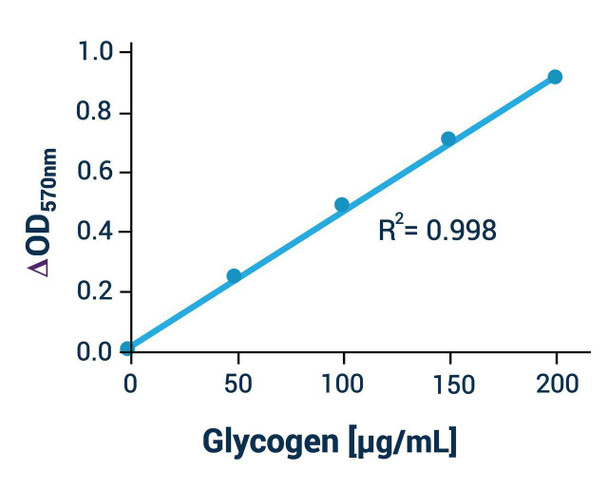
Subtract the blank reading (OD at 570 nm or fluorescence) from the standard readings and plot the change in OD or fluorescence against standard concentrations to determine the slope. Glycogen = (Rsample - Rblank) / slope ug/mL, where Rsample and Rblank are the values of the sample and blank.
| Component | Quantity | Storage |
| Assay Buffer | 12 mL | -20C |
| Enzyme A (dried) | 1 vial | -20C |
| Enzyme B | 120 uL | -20C |
| Dye Reagent | 120 uL | -20C |
| Standard (50 mg/mL) | 50 uL | -20C |