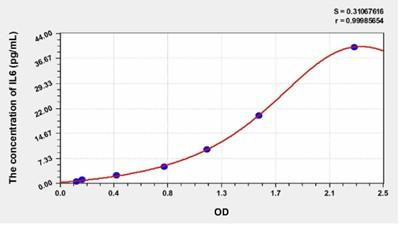
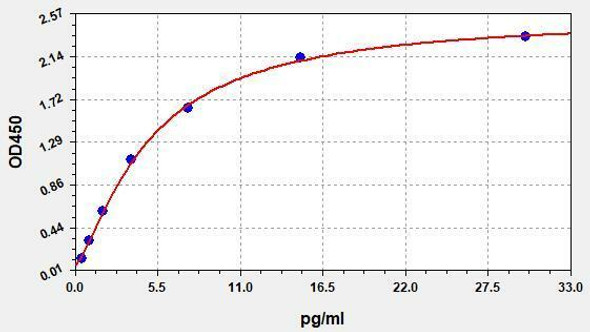
Description
| Product Name: | High Sensitivity Human IL6 (Interleukin 6) ELISA Kit |
| SKU: | AEKE12431 |
| Size: | 96 Assays |
| Synonyms: | Interleukin-6, IL-6 |
| Reactivity: | Human |
| Assay Type: | Sandwich |
| Sensitivity: | 0.05 pg/mL |
| Range: | 0.63-40 pg/mL |
| Standard: | 40 pg/mL |
| Assay Length: | 4 h |
| Sample Type: | Serum, Plasma |
| Kit Components: |
| ||||||||||||||||||||||||||||||||||||||||||||||||||||||||
The Assay Genie High Sensitivity Human IL6 (Interleukin 6) ELISA Kit is a highly sensitive assay for the quantitative measurement of IL6 in serum and plasma samples. This kit utilizes a sandwich enzyme-linked immunosorbent assay (ELISA) format. An antibody specific to the target protein is pre-coated onto the wells of a 96-well microplate. Samples and standards are added to the wells, allowing the target to bind to the immobilized antibody. After incubation, unbound substances are removed through washing. A biotinylated detection antibody is then added, which binds specifically to the captured target. Following a second wash to remove excess detection antibody, HRP-conjugated Streptavidin is introduced, forming a biotin-streptavidin-HRP complex. After a third washing step, TMB substrate is added to initiate a colorimetric reaction catalysed by HRP. The reaction produces a blue product that turns yellow upon addition of the acidic Stop Solution. The optical density (OD) is measured at 450 nm using a microplate reader. The OD450 value is directly proportional to the concentration of the target analyte in the sample, which can be determined by referencing a standard curve.
| Specificity: | This assay has high sensitivity and excellent specificity for detection of Human IL6. No significant cross-reactivity or interference between Human IL6 and other targets was observed. Note: Limited by current skills and knowledge, it is difficult for us to complete the cross-reactivity detection between Human IL6 and other analytes, therefore, cross reaction may still exist. | ||||||||||||||||||||
| Recovery: |
| ||||||||||||||||||||
| Linearity: |
| ||||||||||||||||||||
| Precision: | Intra-assay Precision (Precision within an assay):CV%<8% Three samples of known concentration were tested twenty times on one plate to assess intra-assay precision. Inter-assay Precision (Precision between assays):CV%<10% Three samples of known concentration were tested in forty separate assays to assess inter-assay precision. |
*Note:The below protocol is a sample protocol. Protocols are specific to each batch/lot. For the correct instructions please follow the protocol included in your kit.
| Step | Protocol |
| 1. | After the kit is equilibrated at room temperature, add 100 μL of Standard Working Solution (gradually diluted according to the instructions) or 100 μL of sample to each well, and incubate at 37°C for 80 minutes. |
| 2. | Discard the liquid in the plate, add 200 μL 1× Wash Buffer to each well, and wash the plate 3 times. After pat it dry against clean absorbent paper, add 100 μL Biotinylated Antibody Working Solution (1×) to each well, incubate at 37°C for 50 minutes. |
| 3. | Discard the liquid in the plate, add 200 μL 1× Wash Buffer to each well, and wash the plate 3 times. After pat it dry against clean absorbent paper, add 100 μL 1× Streptavidin-HRP Working Solution to each well, incubate at 37°C for 50 minutes. |
| 4. | Discard the liquid in the plate, add 200 μL 1× Wash Buffer to each well, and wash the plate 5 times. After pat it dry against clean absorbent paper, add 90 μL TMB Substrate Solution to each well, incubate at 37°C for 20 minutes in the dark. |
| 5. | Add 50 μL Stop Solution to each well, shake plate on a plate shaker for 1 minute to mix. Record the OD at 450 nm immediately, calculation of the results. |
When carrying out an ELISA assay it is important to prepare your samples in order to achieve the best possible results. Below we have a list of procedures for the preparation of samples for different sample types.
| Sample Type | Protocol |
| Serum | Allow whole blood to coagulate at room temperature (2 h) or 2-8°C overnight. Centrifuge at 1000 × g for 20 min and collect the supernatant. Store or use immediately. |
| Plasma | Collect in anticoagulant tubes (EDTA, citrate, or heparin), mix gently, and centrifuge within 30 min at 1000 × g, 2-8°C for 15 min. Store or assay as needed. |
| Tissue homogenates | 1. Rinse the tissues in pre-cooled PBS to completely remove excess blood, and weigh them before homogenization. 2. Mince the tissues and homogenize in fresh lysis buffer (PBS for most tissues). Use a glass homogenizer on ice. 3. Ultrasound the suspension until the solution is clear. 4. Centrifuge for 5 minutes at 10000 × g, collect the supernatant and assay immediately or store at ≤ -20°C. |
| Cell lysates | 1. Wash adherent cells with PBS, detach with trypsin, and centrifuge at 1000 × g for 5 minutes. 2. Wash cells 3 times in PBS. 3. Resuspend cells in fresh lysis buffer at 10⁷ cells/mL. Ultrasound if necessary. 4. Centrifuge at 1500 × g for 10 minutes at 2-8°C to remove debris. Assay immediately or store at ≤ -20°C. |
| Urine | Collect mid-stream first urine of the day directly into a sterile container. Centrifuge to remove particulate matter. Assay immediately or aliquot and store at ≤ -20°C. Avoid repeated freeze-thaw cycles. |
| Saliva | Collect saliva using a collection device. Centrifuge at 1000 × g for 15 minutes at 2-8°C. Remove particulates and assay immediately or aliquot and store at ≤ -20°C. Avoid repeated freeze-thaw cycles. |
| Feces | Dry feces weighing more than 50 mg were collected. Wash with PBS (w:v = 1:9). Sonicate and centrifuge at 5000 × g for 10 minutes. Collect the supernatant and assay immediately. |
| CSF (Cerebrospinal fluid) | Remove particulates by centrifugation. Assay immediately or aliquot and store at ≤ -20°C. Avoid repeated freeze-thaw cycles. |
| Cell culture supernatant | Centrifuge samples at 1000 × g for 20 minutes. Collect the supernatant and assay immediately or store at -20°C or -80°C. Avoid repeated freeze-thaw cycles. |
| Uniprot ID: | P05231 |
| Research Area: | Immunology, Inflammation, Cytokine Research |