

Transforming growth factor beta (TGF-β) is a multifunctional cytokine that plays a critical role in various biological processes, including cell growth, differentiation, and immune regulation. It is part of a superfamily of proteins known for their ability to control cellular functions and influence tissue development. TGF-β is involved in numerous physiological and pathological processes, such as embryogenesis, wound healing, inflammation, and cancer progression. By measuring the levels of TGF-β in biological samples, such as serum or cell culture supernatants, the TGF Beta ELISA kit provides a valuable tool for researchers and clinicians to study the role of TGF-β in disease mechanisms, monitor treatment responses, and explore potential therapeutic interventions.
Description
Human TGF-beta ELISA Kit
Key Features
| Save Time | Pre-coated 96 well plate | |
| Quick Start | Kit includes all necessary reagents | |
| Publication Ready | Reproducible and reliable results |
Overview
| Product Name: | Human TGF-beta ELISA Kit |
| Product Code: | HUFI00248 |
| Size: | 96 Assays |
| Alias: | TGF-beta1, Transforming Growth Factor Beta 1, TGF-B1, TGFB, TGFbeta, CED, DPD1, TGFbeta1 |
| Detection Method: | Sandwich ELISA, Double Antibody |
| Application: | This immunoassay kit allows for the in vitro quantitative determination of Human TGF-beta1 concentrations in serum plasma and other biological fluids. |
| Sensitivity: | 18.75pg/ml |
| Range: | 31.25-2000pg/ml |
| Storage: | 4°C for 6 months |
| Note: | For Research Use Only |
Additional Information
| Recovery | Matrices listed below were spiked with certain level of Human TGF-beta1 and the recovery rates were calculated by comparing the measured value to the expected amount of Human TGF-beta1 in samples.
| ||||||||||||||||||||
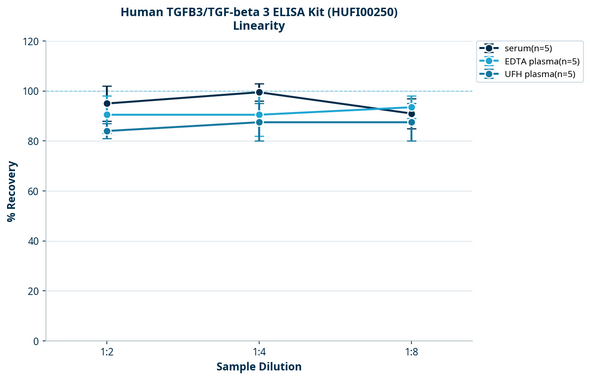
| Linearity | The linearity of the kit was assayed by testing samples spiked with appropriate concentration of Human TGF-beta1 and their serial dilutions. The results were demonstrated by the percentage of calculated concentration to the expected.
| ||||||||||||||||||||
| CV(%) | Intra-Assay: CV<8% |
Kit Components
| Component | Quantity | Storage |
| ELISA Microplate (Dismountable) | 8x12 strips | 4°C for 6 months |
| Lyophilized Standard | 2 | 4°C/ -20°C |
| Sample/Standard Dlution Buffer | 20ml | 4°C |
| Biotin-labeled Antibody (Concentrated) | 120ul | 4°C (Protection from light) |
| Antibody Dilution Buffer | 10ml | 4°C |
| HRP-Streptavidin Conjugate (SABC) | 120ul | 4°C (Protect from light) |
| SABC Dilution Buffer | 10ml | 4°C |
| TMB Substrate | 10ml | 4°C (Protection from light) |
| Stop Solution | 10ml | 4°C |
| Wash Buffer (25X) | 30ml | 4°C |
| Plate Sealer | 5 | - |
Other materials required:
- Microplate reader with 450 nm wavelength filter
- Multichannel Pipette, Pipette, microcentrifuge tubes and disposable pipette tips
- Incubator
- Deionized or distilled water
- Absorbent paper
- Buffer resevoir
Protein Information
Protocol
*Note: Protocols are specific to each batch/lot. For the exact instructions please follow the protocol included in your kit.
Before adding to wells, equilibrate the SABC working solution and TMB substrate for at least 30 min at 37°C. When diluting samples and reagents, they must be mixed completely and evenly. It is recommended to plot a standard curve for each test.
| Step | Procedure |
| 1. | Set standard, test sample and control (zero) wells on the pre-coated plate respectively, and then, record their positions. It is recommended to measure each standard and sample in duplicate. Wash plate 2 times before adding standard, sample and control (zero) wells! |
| 2. | Aliquot 0.1ml standard solutions into the standard wells. |
Related Products

Human TGFB2/TGF-beta 2 ELISA Kit (HUFI00249)
€649
1 Citations
img:cited-250-x-100-px-125-x-75-px-.png


Human TGF-beta RII PharmaGenie ELISA Kit (SBRS1143)
€999

Human TGFB3/TGF-beta 3 ELISA Kit (HUFI00250)
€649

Human TGF-beta RIII PharmaGenie ELISA Kit (SBRS1144)
€999
|
