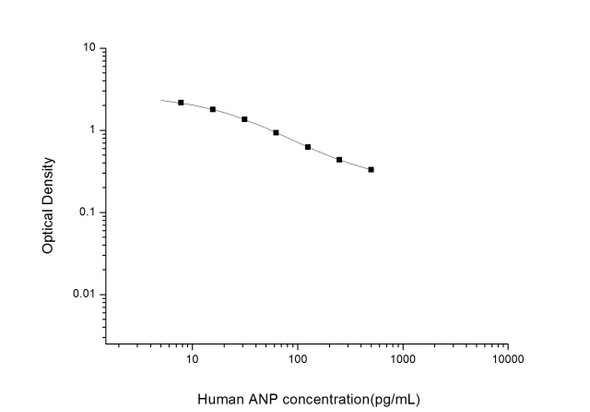
The Rat ANP (Atrial Natriuretic Peptide) ELISA Kit is precisely tailored to enable the quantitative determination of Atrial Natriuretic Peptide (ANP) levels in a variety of rat biological samples. ANP, a vital hormone prominently secreted from the heart, plays a key role in regulating blood pressure, fluid balance, and electrolyte homeostasis. Its involvement in cardiovascular physiology and pathophysiology underscores the importance of accurate ANP measurement in comprehending cardiovascular health, cardiovascular diseases, and renal function. With a focus on sensitivity and specificity, Assay Genie's ANP ELISA Kit ensures accurate and reproducible results, making it the ideal choice for researchers aiming to explore the intricate roles of ANP in cardiovascular and renal research. Manufactured under rigorous quality control standards, this kit ensures robust performance and user-friendly protocols, enhancing its value for a wide range of scientific investigations.
Product Name:
Rat ANP (Atrial Natriuretic Peptide) ELISA Kit
SKU:
AEES00299
Size:
96 Assays
Detection Method:
Colorimetric method, ELISA, Competitive
Assay type:
Competitive-ELISA
Assay time:
2 h 30 min
Sensitivity:
9.38 pg/mL
Detection range:
15.63-1000 pg/mL
Reovery:
80%-120%
This ELISA kit uses the Competitive-ELISA principle. The micro ELISA plate provided in this kit has been pre-coated with the target antigen. Standards or samples are added along with a biotinylated detection antibody. The target antigen present in the sample competes with the immobilized antigen for binding to the detection antibody. After incubation, Avidin-Horseradish Peroxidase (HRP) conjugate is added. Free components are washed away. The substrate solution is then added, resulting in a color change. The intensity of the color is inversely proportional to the concentration of the target antigen in the sample. The reaction is stopped by the addition of stop solution, and the color changes from blue to yellow. The optical density (OD) is measured at 450 nm ± 2 nm. The concentration of the target protein is calculated by comparing the OD values of the samples to the standard curve.