Description
| SKU: | RPCB2692 |
| Size: | 10 μg, 20 μg, 50 μg, 100 μg |
| Tag: | C-6His |
| Reactivity: | Human |
| Protein Description: | Prostatic acid phosphatase (PAP, or ACPP), also known as Prostatic Acid Phosphatase /ACPP is an enzyme produced by the prostate. As a non-specific phosphomonoesterase, Prostatic acid phosphatase is synthesized and secreted into seminal plasma under androgenic control. The enzyme is a dimer of molecular weight around 100 kDa. Prostatic acid phosphatase is a clinically important protein for its relevance as a biomarker of prostate carcinoma. Furthermore, it has a potential role in fertilization. The major action of PAP is to dephosphorylate macromolecules with the help of catalytic residues (His(12) and Asp(258)) that are located in the cleft between two domains. Cellular prostatic acid phosphatase (cPAcP), an authentic tyrosine phosphatase, is proposed to function as a negative growth regulator of prostate cancer (PCa) cells in part through its dephosphorylation of ErbB-2. cPAcP functions as a neutral protein tyrosine phosphatase (PTP) in prostate cancer cells and dephosphorylates HER-2/ErbB-2/Neu (HER-2: human epidermal growth factor receptor-2) at the phosphotyrosine (p-Tyr) residues. Injection of the secretory isoform of PAP has potent antinociceptive effects in mouse models of chronic pain. This enzyme exhibits ecto-5"-nucleotidase activity, is widely distributed, and implicated in the formation of chronic pain. Additionally, PAP could be a target molecule in specific immunotherapy for patients with nonprostate adenocarcinomas including colon and gastric cancers. |
| Endotoxin: | < 0.01 EU/μg of the protein by LAL method |
| Purity: | ≥ 95 % as determined by SDS-PAGE. |
| Formulation: | 0.22 μm filtered solution of 20mM Tris-HCl, 150mM NaCl, pH 7.5. |
| Gene ID: | 55 |
| Storage: | Store at -70°C. This product is stable at ≤ -70°C for up to 1 year from the date of receipt. For optimal storage, aliquot into smaller quantities after centrifugation and store at recommended temperature. Avoid repeated freeze-thaw cycles. |
| Swiss-Prot: | NP_001090.2 |
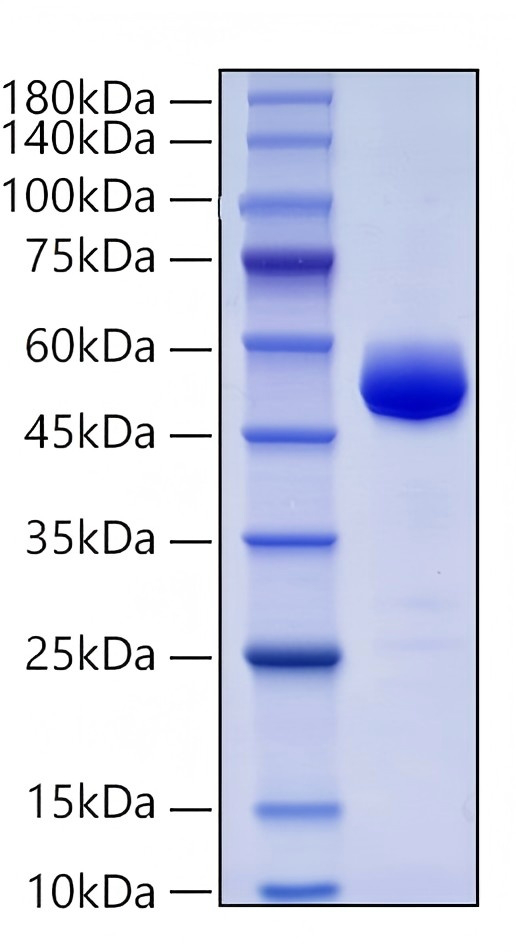 | Recombinant Human Prostatic Acid Phosphatase /ACPP Protein was determined by SDS-PAGE under reducing conditions with Coomassie Blue. |