Description
RPL7A Antibody (CAB13713)
The RPL7A Antibody (CAB13713) is a high-quality antibody developed for reliable detection and analysis of target proteins. RPL7A, also known as Ribosomal Protein L7a, is a component of the ribosome and plays a crucial role in protein synthesis. This polyclonal antibody is raised in rabbits and is highly reactive with human samples, making it an excellent choice for researchers studying protein expression in various cell types. The antibody is validated for use in Western blot applications, allowing for accurate detection and analysis of the RPL7A protein.The RPL7A Polyclonal Antibody (CAB13713) enables researchers to investigate the role of RPL7A in cellular processes and diseases such as cancer, where dysregulation of protein synthesis can have profound effects on cell growth and proliferation.
This antibody is validated for use in WB, IF/ICC, ELISA applications and has demonstrated reactivity against Human, Mouse, Rat samples.
| Product Name: | RPL7A Antibody |
| SKU: | CAB13713 |
| Size: | 20μL, 100μL |
| Reactivity: | Human, Mouse, Rat |
| Conjugate: | Unconjugated |
| Immunogen: | Recombinant protein (or fragment).This information is considered to be commercially sensitive. | ||||||
| Sequence: | MPKG KKAK GKKV APAP AVVK KQEA KKVV NPLF EKRP KNFG IGQD IQPK RDLT RFVK WPRY IRLQ RQRA ILYK RLKV PPAI NQFT QALD RQTA TQLL KLAH KYRP ETKQ EKKQ RLLA RAEK KAAG KGDV PTKR PPVL RAGV NTVT TLVE NKKA QLVV IAHD VDPI ELVV FLPA LCRK MGVP YCII KGKA RLGR LVHR KTCT TVAF TQVN SEDK GALA KLVE AIRT NYND RYDE IRRH WGGN VLGP KSVA RIAK LEKA KAKE LATK LG | ||||||
| Tested Applications: | WB IF/ICC ELISA | ||||||
| Recommended Dilution: |
| ||||||
| Synonyms: | L7A, eL8, TRUP, SURF3, RPL7A |
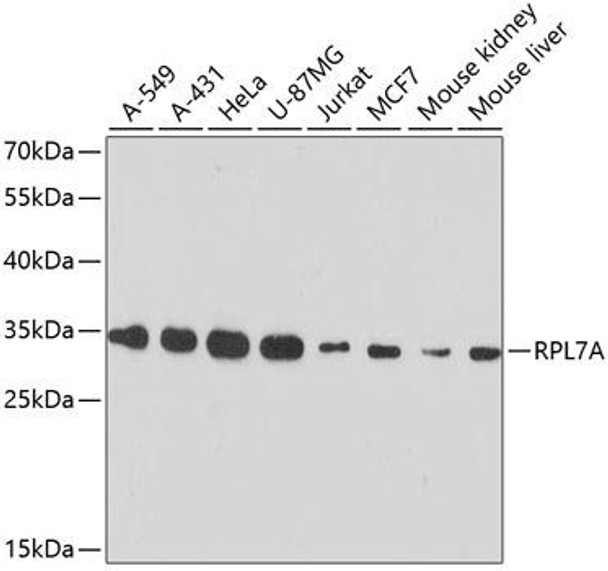
| Positive Sample: | A-549, A-431, HeLa, U-87MG, Jurkat, MCF7, Mouse kidney, Mouse liver |
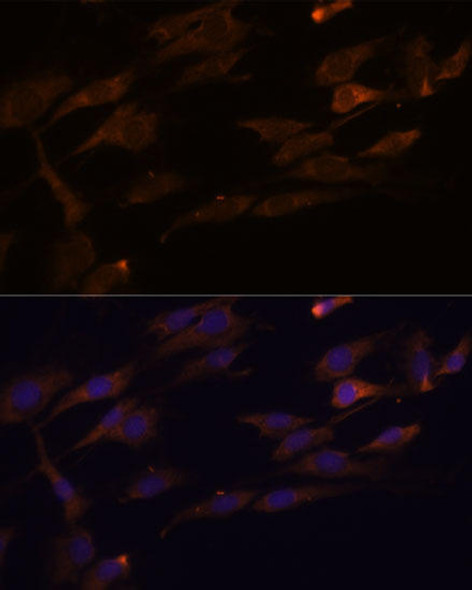
| Cellular Localization: | Cytoplasm, Cytosol, Cytosolic Ribosome, Focal Adhesion, Nucleolus, Nucleus. |
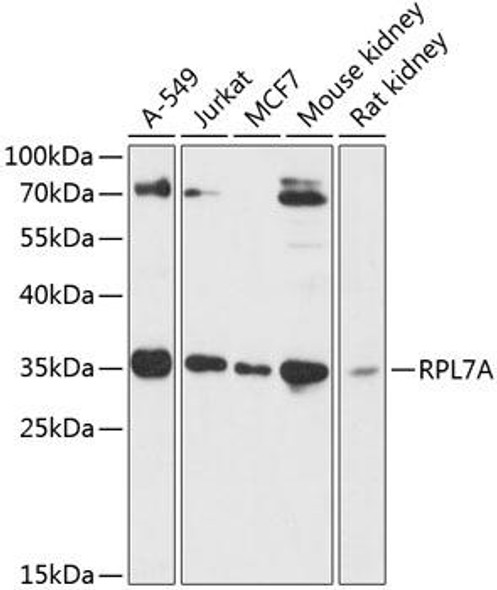
| Calculated MW: | 30kDa |
| Observed MW: | 35kDa |
Cytoplasmic ribosomes, organelles that catalyze protein synthesis, consist of a small 40S subunit and a large 60S subunit. Together these subunits are composed of 4 RNA species and approximately 80 structurally distinct proteins. This gene encodes a ribosomal protein that is a component of the 60S subunit. The protein belongs to the L7AE family of ribosomal proteins. It can interact with a subclass of nuclear hormone receptors, including thyroid hormone receptor, and inhibit their ability to transactivate by preventing their binding to their DNA response elements. This gene is included in the surfeit gene cluster, a group of very tightly linked genes that do not share sequence similarity. It is co-transcribed with the U24, U36a, U36b, and U36c small nucleolar RNA genes, which are located in its second, fifth, fourth, and sixth introns, respectively. This gene rearranges with the trk proto-oncogene to form the chimeric oncogene trk-2h, which encodes an oncoprotein consisting of the N terminus of ribosomal protein L7a fused to the receptor tyrosine kinase domain of trk. As is typical for genes encoding ribosomal proteins, there are multiple processed pseudogenes of this gene dispersed through the genome.
| Purification Method | Affinity purification |
| Gene ID | 6130 |
| RRID | AB_2760573 |
| Buffer Information | Store at -20℃. Avoid freeze / thaw cycles. Buffer: PBS with 0.09% Sodium azide,50% glycerol,pH7.3. |
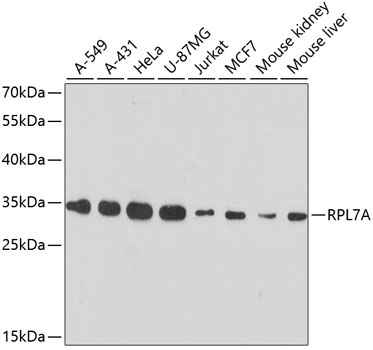 | Western blot analysis of various lysates using RPL7A Rabbit pAb (CAB13713) at 1:3000 dilution. Secondary antibody: HRP-conjugated Goat anti-Rabbit IgG (H+L) (CABS014) at 1:10000 dilution. Lysates/proteins: 25μg per lane. Blocking buffer: 3% nonfat dry milk in TBST. Detection: ECL Basic Kit (AbGn00020). Exposure time: 90s. |
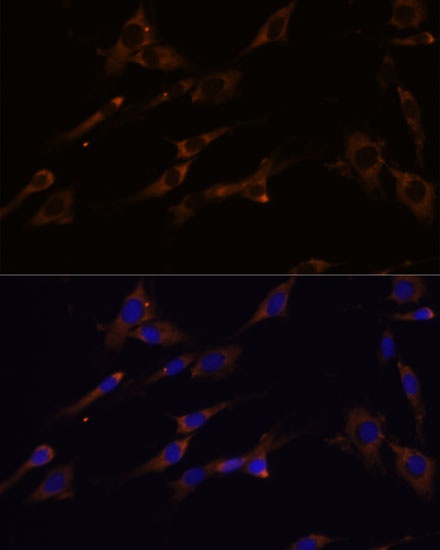 | Immunofluorescence analysis of C6 cells using RPL7A Rabbit pAb (CAB13713) at dilution of 1:100 (40x lens). Secondary antibody: Cy3-conjugated Goat anti-Rabbit IgG (H+L) (CABS007) at 1:500 dilution. Blue: DAPI for nuclear staining. |