The FLC Polyclonal Antibody (CAB21962) is a high-quality antibody developed for reliable detection and analysis of target proteins. This antibody, generated in rabbits, is highly specific for human samples and has been validated for use in Western blot applications. By binding to the FLC protein, this antibody enables detection and analysis in a variety of cell types, making it ideal for studies in immunology and cancer research.FLC, also known as an immune regulator, plays a key role in maintaining immune homeostasis and modulating inflammatory responses. Its involvement in immune system function makes it a crucial target for research into diseases such as cancer, autoimmune disorders, and chronic inflammatory conditions.
This antibody is validated for use in WB, ELISA applications and has demonstrated reactivity against Arabidopsis thaliana samples.
Product Name:
FLC Polyclonal Antibody
SKU:
CAB21962
Size:
20μL, 100μL
Reactivity:
Arabidopsis thaliana
Conjugate:
Unconjugated
Immunogen:
Recombinant protein (or fragment).This information is considered to be commercially sensitive.
Recommended starting concentration is 1 μg/mL. Please optimize the concentration based on your specific assay requirements.
Synonyms:
AGAMOUS-like 25, AGL25, FLF, FLOWERING LOCUS C, FLOWERING LOCUS F, MADS BOX PROTEIN FLOWERING LOCUS F, REDUCED STEM BRANCHING 6, RSB6, T31P16.130, T31P16_130, FLC
Positive Sample:
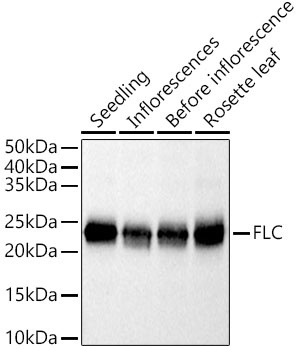
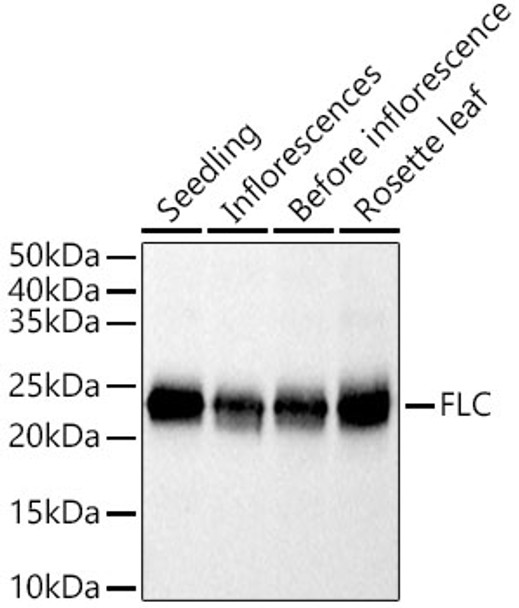
Seedling, Inflorescences, Before inflorescence, Rosette leaf
Cellular Localization:
Nucleus.
Calculated MW:
22kDa
Observed MW:
22kDa
MADS-box protein encoded by FLOWERING LOCUS C - transcription factor that functions as a repressor of floral transition and contributes to temperature compensation of the circadian clock. Expression is downregulated during cold treatment. Vernalization, FRI and the autonomous pathway all influence the state of FLC chromatin. Both maternal and paternal alleles are reset by vernalization, but their earliest activation differs in timing and location. Histone H3 trimethylation at lysine 4 and histone acetylation are associated with active FLC expression, whereas histone deacetylation and histone H3 dimethylation at lysines 9 and 27 are involved in FLC repression. Expression is also repressed by two small RNAs (30- and 24-nt) complementary to the FLC sense strand 3? to the polyA site. The small RNAs are most likely derived from an antisense transcript of FLC. Interacts with SOC1 and FT chromatin in vivo. Member of a protein complex.
Purification Method
Affinity purification
Gene ID
830878
Buffer Information
Store at -20℃. Avoid freeze / thaw cycles. Buffer: PBS containing 50% glycerol, preserved with proclin300 or sodium azide, pH 7.3.
Western blot analysis of extracts of various tissues from Arabidopsis thaliana, using FLC Rabbit pAb (CAB21962) at 1:400 dilution. Secondary antibody: HRP-conjugated Goat anti-Rabbit IgG (H+L) (CABS014) at 1:10000 dilution. Lysates/proteins: 25μg per lane. Blocking buffer: 3% nonfat dry milk in TBST. Detection: ECL Basic Kit (AbGn00020). Exposure time: 0.5s.