Description
Glucose Dehydrogenase Assay Kit (Colorimetric) (BA0024) (BA0024)
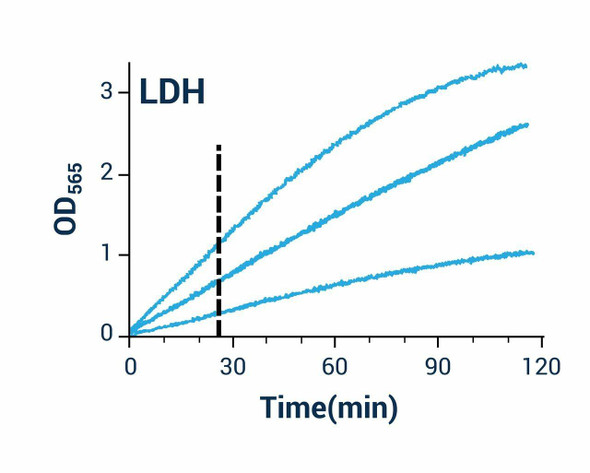
The Glucose Dehydrogenase Assay Kit (Colorimetric) (SKU: BA0024) is a non-radioactive, colorimetric assay for the quantitative determination of glucose dehydrogenase (GDH) activity in biological samples. GDH belongs to the oxidoreductase family and participates in the pentose phosphate pathway. In this kit GDH activity is coupled to the reduction of the tetrazolium salt MTT via an NADH-linked reaction, producing a reduced form of MTT with an absorption maximum at 565 nm. The increase in absorbance at 565 nm is proportional to the enzyme activity, giving a linear detection range of 0.5 to 200 U/L over a fifteen-minute reaction. The homogeneous mix-incubate-measure format is convenient and can be automated on high-throughput liquid-handling systems. It is suitable for plasma, serum, tissue and culture media.
| Product Name: | Glucose Dehydrogenase Assay Kit (Colorimetric) (BA0024) |
| SKU: | BA0024 |
| Detection Method: | Colorimetric kinetic; NADH-coupled reduction of MTT (OD565nm) |
| Detection Range: | 0.5 to 200 U/L for a 15-minute reaction (20 µL sample) |
| Sample Type: | Plasma, serum, tissue, culture media |
| Species Reactivity: | All |
| Assay Time: | 15 minutes |
| Kit Size: | 100 Assays |
| Equipment Required: | Microplate reader |
| Storage: | Store all components at -20°C upon receipt. |
| Shelf Life: | 11 months after receipt. |
| Shipping: | Room Temperature |
A non-radioactive, colorimetric kinetic assay for the quantitative determination of glucose dehydrogenase (GDH) activity. GDH activity is coupled through an NADH-linked reaction to the reduction of the tetrazolium salt MTT; the increase in absorbance at 565 nm is proportional to enzyme activity. Linear detection range is 0.5 to 200 U/L for a 15-minute reaction.
- Fast and sensitive: linear detection range 0.5 to 200 U/L for a 15-minute reaction (20 µL sample).
- Convenient and high-throughput: homogeneous mix-incubate-measure format, readily automated on HTS liquid-handling systems.
- GDH activity determination in biological samples such as plasma, serum, tissue and culture media.
Note: The below protocol is a sample protocol. Protocols are specific to each batch/lot. For the correct instructions please follow the protocol included in your kit.
| Step | Procedure |
| 1 | Sample preparation: assay serum and plasma directly. Homogenise tissue (50 mg) in ~200 µL 50 mM potassium phosphate (pH 7.5) and centrifuge at 10,000 g for 15 min at 4°C; prepare cell lysates similarly. Samples may be stored at -20 to -80°C for at least one month. |
| 2 | Reagent preparation: equilibrate reagents to the reaction temperature. Prepare Working Reagent per 96-well assay by mixing 8 µL Substrate, 8 µL NAD/MTT Solution, 1 µL Diaphorase and 70 µL Assay Buffer. |
| 3 | Transfer 100 µL H2O and 100 µL Calibrator into wells of a clear flat-bottom 96-well plate. |
| 4 | Transfer 20 µL of each sample into separate wells and add 80 µL Working Reagent to each. Tap briefly to mix. |
| 5 | Read OD565nm (OD0) immediately and again after 15 min (OD15). |
Subtract OD0 from OD15 for each sample to compute ΔODs. GDH Activity = (ΔODs / t) x [273 / (ODCAL - ODH2O)] x n (U/L), where t is the reaction time (15 min recommended) and n is the dilution factor. One unit converts 1 µmole of NAD to NADH per minute at pH 8.2.
| Component | Quantity | Storage |
| Assay Buffer | 10 mL | -20°C |
| Diaphorase | 120 µL | -20°C |
| NAD/MTT | 1 mL | -20°C |
| Calibrator | 1.5 mL | -20°C |
| Substrate | 1 mL | -20°C |