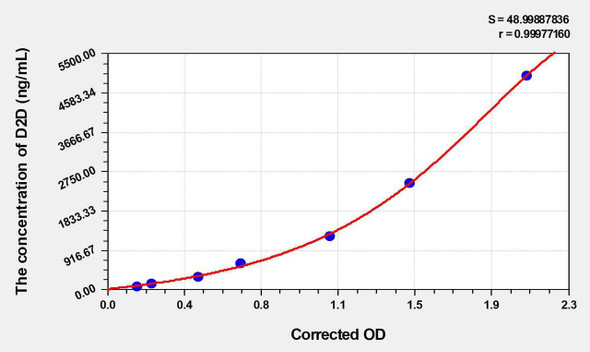
The Mouse D2D (D-Dimer) ELISA Kit is designed for the quantitative detection of Mouse D2D (D-Dimer) levels in various biological samples. D-Dimer is a small fibrin degradation product released into circulation when plasmin cleaves cross-linked fibrin during fibrinolysis. Its detection serves as an indirect marker of thrombus formation and dissolution, making it an indispensable diagnostic and prognostic tool for venous thromboembolism (VTE), pulmonary embolism (PE), deep vein thrombosis (DVT), and disseminated intravascular coagulation (DIC). Elevated D-Dimer concentrations have also been associated with COVID-19 severity, cancer-associated thrombosis, and sepsis-related coagulopathy. Assay Genie's Mouse D2D (D-Dimer) ELISA Kit offers exceptional sensitivity and specificity with a sensitivity of 46.88 ng/mL, ensuring reliable and reproducible results across a broad range of sample types including plasma. Manufactured under stringent quality control standards, this ELISA kit provides robust performance and ease of use, making it an outstanding choice for both research and clinical applications. Trust Assay Genie's Mouse D2D (D-Dimer) ELISA Kit for accurate and dependable quantification of this crucial biomarker in your studies.
Product Name:
Mouse D2D (D-Dimer) ELISA Kit
SKU:
AEES00189
Size:
96 Assays
Detection Method:
Colorimetric method, ELISA, Competitive
Assay type:
Competitive-ELISA
Assay time:
2 h 30 min
Sensitivity:
46.88 ng/mL
Detection range:
78.13-5000 ng/mL
Reovery:
80%-120%
This ELISA kit uses the Competitive-ELISA principle. The micro ELISA plate provided in this kit has been pre-coated with the target antigen. Standards or samples are added along with a biotinylated detection antibody. The target antigen present in the sample competes with the immobilized antigen for binding to the detection antibody. After incubation, Avidin-Horseradish Peroxidase (HRP) conjugate is added. Free components are washed away. The substrate solution is then added, resulting in a color change. The intensity of the color is inversely proportional to the concentration of the target antigen in the sample. The reaction is stopped by the addition of stop solution, and the color changes from blue to yellow. The optical density (OD) is measured at 450 nm ± 2 nm. The concentration of the target protein is calculated by comparing the OD values of the samples to the standard curve.