The ACE1 Monoclonal Antibody (CAB11357) is a high-quality antibody developed for reliable detection and analysis of target proteins. This antibody is produced using rabbit monoclonal technology, ensuring high affinity and low background in various applications such as immunohistochemistry and flow cytometry.ACE1, also known as angiotensin-converting enzyme 1, is a key player in the renin-angiotensin system, which regulates blood pressure and electrolyte balance in the body. Dysregulation of ACE1 activity has been implicated in cardiovascular diseases such as hypertension and heart failure, making it an important target for drug development and disease understanding.
This antibody is validated for use in WB, IP, ELISA applications and has demonstrated reactivity against Mouse, Rat samples.
Product Name:
ACE1 Monoclonal Antibody
SKU:
CAB11357
Size:
20μL, 100μL
Reactivity:
Mouse, Rat
Clone Number:
ARC0577
Conjugate:
Unconjugated
Immunogen:
Synthetic peptide. This information is considered to be commercially sensitive.
0.5μg-4μg antibody for 400μg-600μg extracts of whole cells
ELISA
Recommended starting concentration is 1 μg/mL. Please optimize the concentration based on your specific assay requirements.
Synonyms:
DCP, ACE1, DCP1, CD143
Positive Sample:
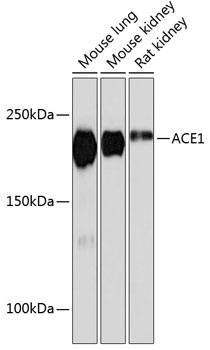
Mouse lung, Mouse kidney, Rat kidney
Cellular Localization:
Cell Membrane, Cytoplasm, Secreted, Single-Pass Type I Membrane Protein.
Calculated MW:
150kDa
Observed MW:
170kDa
This gene encodes an enzyme involved in blood pressure regulation and electrolyte balance. It catalyzes the conversion of angiotensin I into a physiologically active peptide angiotensin II. Angiotensin II is a potent vasopressor and aldosterone-stimulating peptide that controls blood pressure and fluid-electrolyte balance. This angiotensin converting enzyme (ACE) also inactivates the vasodilator protein, bradykinin. Accordingly, the encoded enzyme increases blood pressure and is a drug target of ACE inhibitors, which are often prescribed to reduce blood pressure. This enzyme additionally plays a role in fertility through its ability to cleave and release GPI-anchored membrane proteins in spermatozoa. Many studies have associated the presence or absence of a 287 bp Alu repeat element in this gene with the levels of circulating enzyme. This polymorphism, as well as mutations in this gene, have been implicated in a wide variety of diseases including cardiovascular pathophysiologies, psoriasis, renal disease, stroke, and Alzheimer's disease. Regulation of the homologous ACE2 gene may be involved in progression of disease caused by several human coronaviruses, including SARS-CoV and SARS-CoV-2. Alternative splicing results in multiple transcript variants encoding both somatic (sACE) and male-specific testicular (tACE) isoforms.
Purification Method
Affinity purification
Gene ID
1636
RRID
AB_2861550
Buffer Information
Store at -20℃. Avoid freeze / thaw cycles. Buffer: PBS containing 50% glycerol and 0.05% BSA, preserved with proclin300 or sodium azide, pH 7.3.
Western blot analysis of various lysates using ACE1 Rabbit mAb (CAB11357) at 1:1000 dilution. Secondary antibody: HRP-conjugated Goat anti-Rabbit IgG (H+L) (CABS014) at 1:10000 dilution. Lysates/proteins: 25μg per lane. Blocking buffer: 3% nonfat dry milk in TBST. Detection: ECL Basic Kit (AbGn00020). Exposure time: 30s.
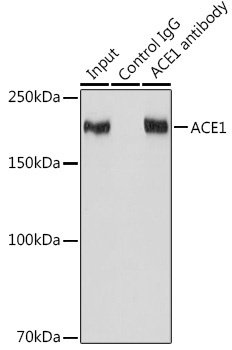
Immunoprecipitation analysis of 600 μg extracts of Mouse kidney cells using 3 μg ACE1 antibody (CAB11357). Western blot was performed from the immunoprecipitate using ACE1 antibody (CAB11357) at a dilution of 1:1000.