Description
Cell Viability Assay (Colorimetric/Fluorometric) (BA0003) (BA0003)
The Cell Viability Assay (Colorimetric/Fluorometric) (SKU: BA0003) is a homogeneous, non-radioactive fluorescent assay for measuring cell proliferation and cytotoxicity. It uses the redox dye resazurin, which is non-fluorescent but is converted by metabolically active cells into the highly fluorescent product resorufin. Because only viable cells can reduce the reagent, the fluorescence intensity provides a true measure of the number of living cells. The single-reagent mix-incubate-measure format is compatible with all culture media and liquid-handling systems, supporting high-throughput screening in 96-well and 384-well plates. This 10,000-assay format is well suited to cell proliferation studies, cytotoxicity and apoptosis testing, and anticancer drug discovery.
| Product Name: | Cell Viability Assay (Colorimetric/Fluorometric) (BA0003) |
| SKU: | BA0003 |
| Detection Method: | Fluorometric (Ex 530-570 nm / Em 590-620 nm) |
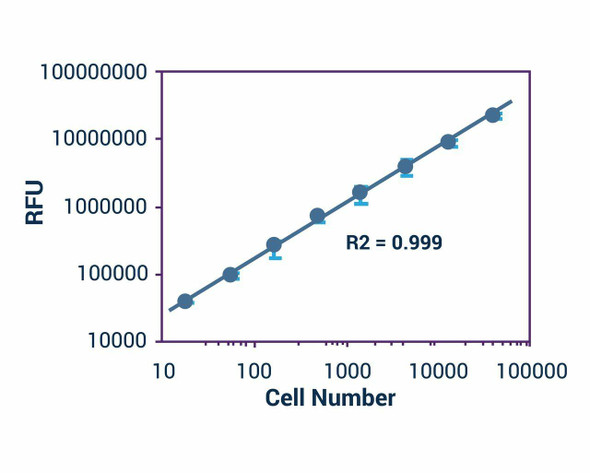
| Detection Range: | As low as 100 cells can be accurately quantified |
| Sample Type: | ['Adherent cells', 'Suspension cells', 'Cultured cells'] |
| Species Reactivity: | All |
| Assay Time: | 1 to 5 hours incubation |
| Kit Size: | 10,000 Assays |
| Equipment Required: | Microplate reader |
| Storage: | 4°C (Reagent, in provided amber bottle; light sensitive) |
| Shelf Life: | 12 months after receipt |
| Shipping: | Room Temperature |
This homogeneous assay involves simply adding a single reagent to the cell culture and measuring the fluorescence intensity (excitation 530-570 nm, emission 590-620 nm) after an incubation step. The reagent utilises the redox dye resazurin, which is not fluorescent but upon reduction by metabolically active cells is converted into the highly fluorescent product resorufin. Living cells readily reduce this non-toxic reagent and the resulting increase in fluorescence intensity can be conveniently monitored using a fluorescence spectrophotometer or plate reader. Non-viable cells have no metabolic capacity and will not reduce the dye, so the fluorescence intensity observed is a true measure of the viable cells. The reagent is compatible with all culture media and with all liquid-handling systems for high-throughput screening in 96-well and 384-well plates.
- Safe. Non-radioactive assay.
- Sensitive and accurate. As low as 100 cells can be accurately quantified.
- Time efficient. High-throughput assay in 96-well and 384-well plates allows simultaneous processing of tens of thousands of samples per day.
- Homogeneous and convenient. A single reagent, mix-incubate-measure type assay with no wash or reagent transfer steps.
- Robust and amenable to HTS. Z' factors of 0.6 to 0.9 are routinely observed in 96-well and 384-well plates and it can be readily automated on HTS liquid handling systems.
- Cell Proliferation: effects of cytokines, growth factors and nutrients.
- Cytotoxicity and Apoptosis: evaluation of toxic compounds, anti-cancer antibodies, toxins and environmental pollutants.
- Drug Discovery: high-throughput screening for anticancer drugs.
Note: The below protocol is a sample protocol. Protocols are specific to each batch/lot. For the correct instructions please follow the protocol included in your kit.
| Step | Procedure |
| 1 | Plate and culture cells (80 µL) in black 96-well tissue culture plates. A typical culture medium contains DMEM, 10% fetal bovine serum, antibiotics, amino acids and other nutrients. Assays can be performed on either adherent cells or cells in suspension, with cell numbers from 100 to 80,000 per well and volumes from 50 to 150 µL. Include control wells of culture medium containing no cells, or cells treated with a toxic reagent such as 0.1% saponin. |
| 2 | Add test compounds and controls (20 µL in PBS or culture medium) and incubate cells for the desired period of time, typically overnight, running assays in duplicate or triplicate. |
| 3 | Equilibrate the Reagent to room temperature and add 10 µL (per 100 µL of cell culture) of the reagent per well. Tap the plate to mix cells with compounds and incubate for 1 to 5 hours at 37°C. |
| 4 | Measure fluorescent intensity for each well on a fluorescence plate reader using rhodamine filter sets (530 nm excitation, 590 nm emission, 570 nm dichroic mirror). |
Activity (%) or Cell viability (%) = 100 x (Fcmpd - Fo) / (Fctrl - Fo), where Fcmpd and Fctrl are the average fluorescence intensities in the presence and absence (vehicle control) of the test compound and Fo the averaged blank control fluorescence intensity. For dose-response studies, plot the data against compound concentration and determine EC50 (proliferation) or IC50 (cytotoxicity) by non-linear regression analysis.
| Component | Quantity | Storage |
| Reagent | 100 mL | 4°C (light sensitive, store in amber bottle) |