Description
Urea Assay Kit II (BA0230) (BA0230)
Urea, the major end product of protein catabolism in animals, is primarily produced in the liver and secreted by the kidneys. It is the primary vehicle for the removal of toxic ammonia from the body, and its determination is very useful for assessing kidney function. Increased urea levels are associated with nephritis, renal ischaemia, urinary tract obstruction and certain extrarenal diseases such as congestive heart failure, liver disease and diabetes, whereas decreased levels often indicate acute hepatic insufficiency. The Urea Assay Kit II (SKU: BA0230) is a colorimetric assay based on urease-catalysed conversion of urea to ammonium and carbon dioxide. The pH of the reaction medium is monitored by a chromogen, and the intensity of the reaction product at 557 nm is directly proportional to the urea concentration in the sample. The single-reagent, room-temperature procedure is read after 5 minutes and is readily automated for high-throughput analysis.
| Product Name: | Urea Assay Kit II (BA0230) |
| SKU: | BA0230 |
| Detection Method: | Colorimetric determination at OD557 nm (550-565 nm) |
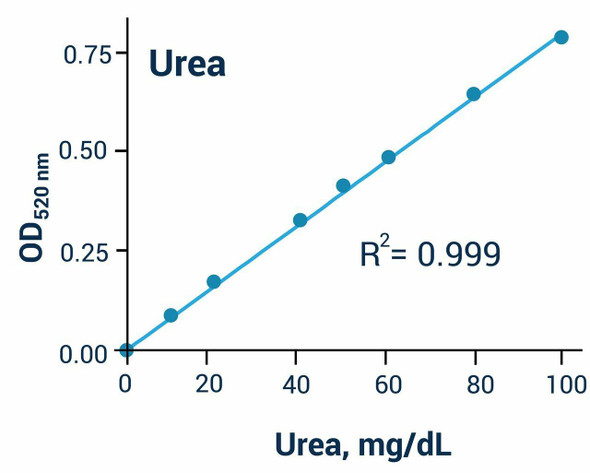
| Detection Range: | 1 mg/dL (0.17 mM) to 100 mg/dL (17 mM) urea (20 µL sample) in a 96-well plate assay |
| Sample Type: | Biological samples (e.g. plasma, serum, urine) and food/beverage samples (e.g. milk) |
| Species Reactivity: | All |
| Assay Time: | 5 minutes |
| Kit Size: | 100 Assays |
| Equipment Required: | Microplate reader |
| Storage: | The kit is shipped at room temperature. Store Reagent and Standard at 4°C upon receiving. Urease can be stored from -20°C to 4°C. For long-term storage, keep Standard at -20°C. |
| Shelf Life: | 6 months after receipt. |
| Shipping: | Room Temperature |
A quantitative colorimetric urea (BUN) assay based on urease-catalysed conversion of urea to ammonium and carbon dioxide. The pH of the reaction medium is monitored by a chromogen and the intensity of the reaction product at 557 nm is directly proportional to the urea concentration in the sample.
- Fast and sensitive. Linear detection range (20 µL sample): 1 mg/dL (0.17 mM) to 100 mg/dL (17 mM) urea in a 96-well plate assay.
- Convenient. The procedure involves adding a single working reagent and reading the absorbance after 5 minutes. Room temperature assay. No 37°C heater is needed.
- High-throughput. Homogeneous “mix-incubate-measure” type assay. Can be readily automated on HTS liquid handling systems for processing thousands of samples per day.
- Urea in biological samples (e.g. plasma, serum, urine) and food/beverage samples (e.g. milk).
Note: The below protocol is a sample protocol. Protocols are specific to each batch/lot. For the correct instructions please follow the protocol included in your kit.
| Step | Procedure |
| 1 | Sample preparation: serum and plasma can be assayed directly after centrifuging to remove particulates (n=1). Milk should be cleared by mixing 600 µL milk with 100 µL 6 N HCl, centrifuging 5 min at 14,000 g, transferring 300 µL supernatant into a clean tube, neutralising with 50 µL 6 N NaOH and diluting the neutralised supernatant 5-fold in distilled water (n=6.8). Urine: dilute 50-fold in distilled water (n=50); urine samples do not require an internal standard. |
| 2 | Reagent preparation: vortex reagent or warm in a bath if there are particulates. Equilibrate Reagent to room temperature. Briefly centrifuge other tubes before use. |
| 3 | Samples require an internal standard and need three separate reactions: (1) sample plus standard, (2) sample alone and (3) sample blank. For sample plus standard, add 5 µL 200 mg/dL urea and 20 µL sample. For sample and sample blank wells, add 5 µL dH2O and 20 µL sample. |
| 4 | Prepare enough Working Reagent (WR) for all samples-plus-standards and samples-alone: for each reaction combine 85 µL Reagent and 1 µL Urease. |
| 5 | Add 80 µL WR to each sample-plus-standard and sample-alone well. Add 80 µL Reagent (no Urease) to each sample blank well. Tap plate to mix briefly and thoroughly. Incubate 5 minutes at room temperature. |
| 6 | Read OD557nm (550-565 nm). |
[Urea] = [(R_Sample – R_Blank) / (R_Standard – R_Sample)] × [Standard]/4 × n (mg/dL) = 50 × [(R_Sample – R_Blank) / (R_Standard – R_Sample)] × n (mg/dL), where R_Sample, R_Blank and R_Standard are OD readings of the Sample, Sample Blank and Sample plus Standard, and n is the sample dilution factor. The internal standard volume is 4× lower than the sample volume, so its concentration is divided by 4. Conversions: BUN (mg/dL) = [Urea] / 2.14; 1 mg/dL urea equals 167 µM, 0.001% or 10 ppm. If the calculated urea concentration exceeds 50 mg/dL, dilute sample in distilled water and repeat the assay, multiplying by n.
| Component | Quantity | Storage |
| Reagent | 10 mL | 4°C |
| Standard (200 mg/dL) | 1 mL | 4°C (long-term -20°C) |
| Urease | 120 µL | -20°C to 4°C |