The WDR4 Monoclonal Antibody (CAB19765) is a high-quality antibody developed for reliable detection and analysis of target proteins. This antibody is raised in rabbits and has high reactivity with human samples, making it suitable for various research applications.WDR4, also known as WD Repeat Domain 4, plays a crucial role in the post-transcriptional modification of RNA and is essential for the proper functioning of the ribosome. Dysregulation of WDR4 has been linked to various diseases, including cancer, making it a promising target for therapeutic interventions.
This antibody is validated for use in WB, IHC-P, ChIP, ELISA applications and has demonstrated reactivity against Human, Mouse, Rat samples.
Product Name:
WDR4 Monoclonal Antibody
SKU:
CAB19765
Size:
20μL, 100μL
Reactivity:
Human, Mouse, Rat
Clone Number:
ARC2292
Conjugate:
Unconjugated
Immunogen:
Synthetic peptide. This information is considered to be commercially sensitive.
Recommended starting concentration is 1 μg/mL. Please optimize the concentration based on your specific assay requirements.
Synonyms:
hWH, Wuho, MIGSB, TRM82, GAMOS6, TRMT82, WDR4
Positive Sample:
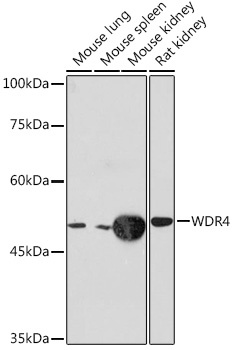
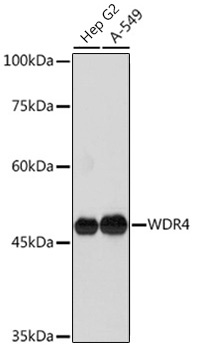
Hep G2, A-549, Mouse lung, Mouse spleen, Mouse kidney, Rat kidney
Cellular Localization:
Cytosol, Nucleoplasm, Nucleus.
Calculated MW:
45kDa
Observed MW:
49kDa
This gene encodes a member of the WD repeat protein family. WD repeats are minimally conserved regions of approximately 40 amino acids typically bracketed by gly-his and trp-asp (GH-WD), which may facilitate formation of heterotrimeric or multiprotein complexes. Members of this family are involved in a variety of cellular processes, including cell cycle progression, signal transduction, apoptosis, and gene regulation. This gene is excluded as a candidate for a form of nonsyndromic deafness (DFNB10), but is still a candidate for other disorders mapped to 21q22.3 as well as for the development of Down syndrome phenotypes. Alternatively spliced transcript variants have been found for this gene.
Purification Method
Affinity purification
Gene ID
10785
Buffer Information
Store at -20℃. Avoid freeze / thaw cycles. Buffer: PBS containing 50% glycerol and 0.05% BSA, preserved with proclin300 or sodium azide, pH 7.3.
Western blot analysis of various lysates using WDR4 Rabbit mAb (CAB19765) at 1:1000 dilution. Secondary antibody: HRP-conjugated Goat anti-Rabbit IgG (H+L) (CABS014) at 1:10000 dilution. Lysates/proteins: 25μg per lane. Blocking buffer: 3% nonfat dry milk in TBST. Detection: ECL Basic Kit (AbGn00020). Exposure time: 10s.
Western blot analysis of various lysates using WDR4 Rabbit mAb (CAB19765) at 1:1000 dilution. Secondary antibody: HRP-conjugated Goat anti-Rabbit IgG (H+L) (CABS014) at 1:10000 dilution. Lysates/proteins: 25μg per lane. Blocking buffer: 3% nonfat dry milk in TBST. Detection: ECL Basic Kit (AbGn00020). Exposure time: 60s.
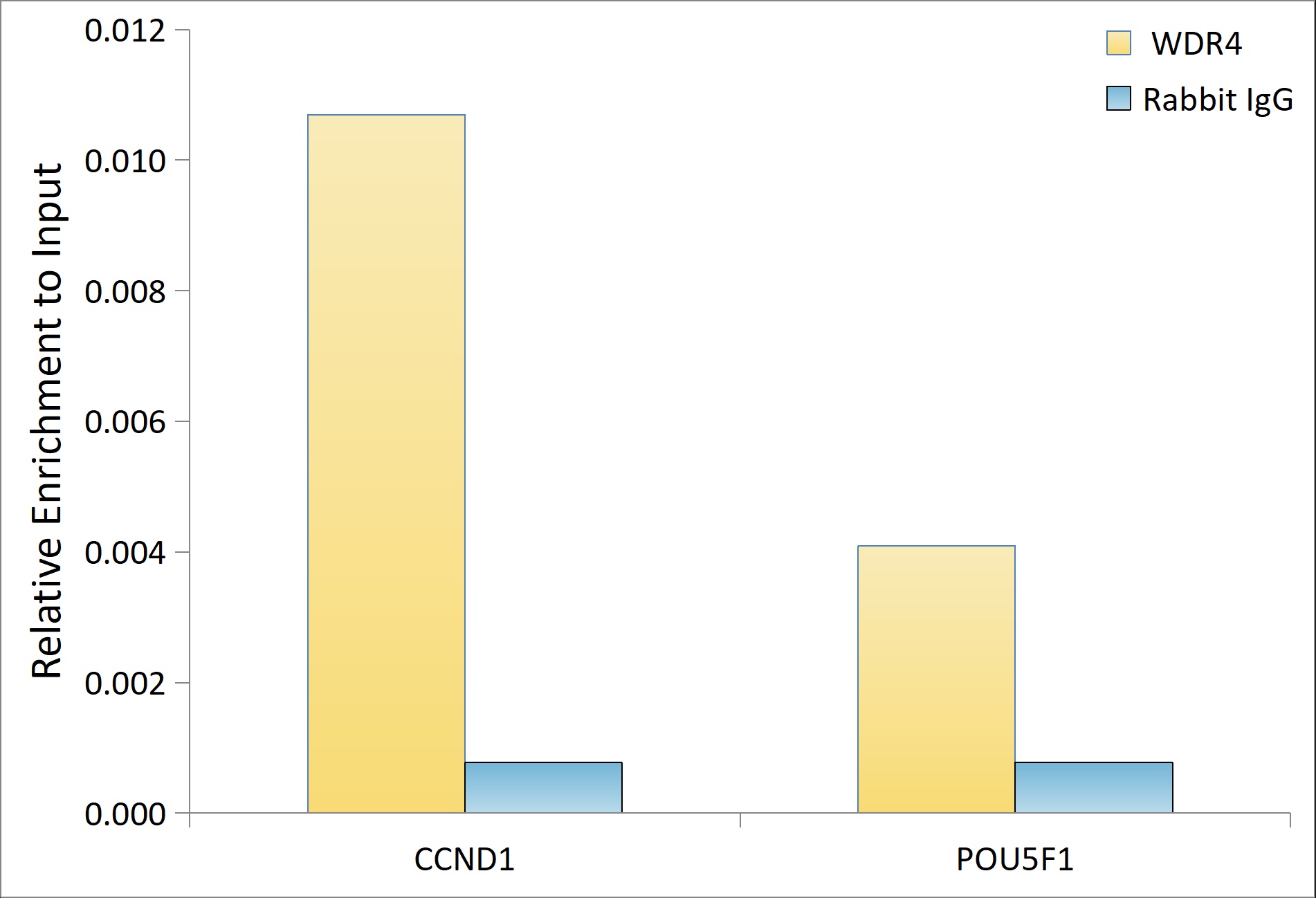
Chromatin immunoprecipitation was performed with 25 μg of cross-linked chromatin from NIH/3T3, using 3 μg of WDR4 Rabbit mAb (CAB19765) and Rabbit IgG isotype control (AC042). The enrichment of immunoprecipitated DNA at different genomic loci was examined by quantitative PCR. The histogram compares the ratio of the immunoprecipitated DNA to the input at given loci.



![Anti-WDR4 [R09-7T8] Monoclonal Antibody (AGMB01185)](https://cdn11.bigcommerce.com/s-h68l9z2lnx/images/stencil/590x590/products/272474/694775/anti-wdr4-r09-7t8-monoclonal-antibody-agmb01185__69690.1774513528.jpg?c=2 "Anti-WDR4 [R09-7T8] Monoclonal Antibody (AGMB01185)")