Description
Ascorbic Acid Assay Kit (BA0077) (BA0077)
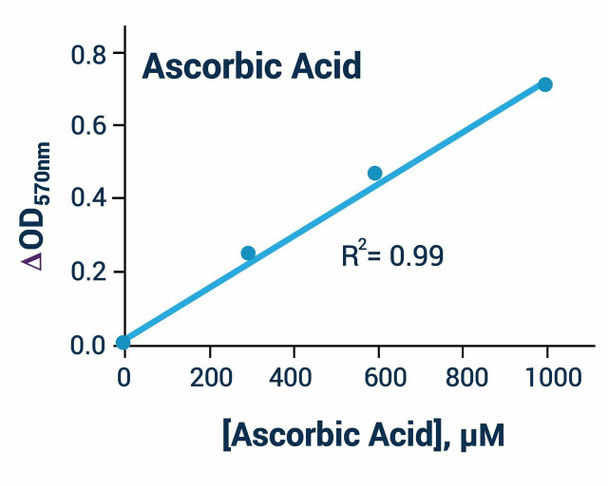
The Ascorbic Acid Assay Kit (SKU: BA0077) provides a simple, direct and high-throughput method for measuring ascorbic acid. Ascorbic acid, the L-enantiomer commonly known as vitamin C, is an important antioxidant found in living organisms and used as an additive in food and other industrial processes; by reacting with reactive oxygen species it protects cells from oxidative damage. In this assay ascorbic acid is oxidised by ascorbate oxidase, producing hydrogen peroxide that reacts with a specific dye to form a pink coloured product. The colour intensity at 570 nm, or fluorescence intensity at excitation/emission 530/585 nm, is directly proportional to the ascorbic acid concentration in the sample.
| Product Name: | Ascorbic Acid Assay Kit (BA0077) |
| SKU: | BA0077 |
| Detection Method: | Colorimetric or Fluorometric |
| Detection Range: | Colorimetric 6 to 1000 uM; fluorometric 1 to 100 uM ascorbic acid |
| Sample Type: | Serum, plasma, urine, saliva, milk, tissue and cell culture |
| Species Reactivity: | All |
| Assay Time: | 10 minutes |
| Kit Size: | 100 Assays |
| Equipment Required: | Microplate reader |
| Storage: | -20C |
| Shelf Life: | 12 months after receipt |
| Shipping: | Gel Pack |
Quantitative colorimetric or fluorometric determination of ascorbic acid. Ascorbic acid is oxidised by ascorbate oxidase to produce hydrogen peroxide, which reacts with a dye read at 570 nm or fluorometrically at excitation/emission 530/585 nm.
- Uses 20 uL sample
- Colorimetric linear detection range 6 to 1000 uM ascorbic acid
- Fluorometric linear detection range 1 to 100 uM ascorbic acid
- Simple, direct and high-throughput format
- Assays of ascorbic acid in serum, plasma, urine, saliva, milk, tissue and cell culture
- Drug discovery and pharmacology: effects of drugs on ascorbic acid metabolism
Note: The below protocol is a sample protocol. Protocols are specific to each batch/lot. For the correct instructions please follow the protocol included in your kit.
| Step | Procedure |
| 1 | Sample treatment. Serum and plasma can be assayed directly. Prepare tissue and cell (10^6-10^7) lysates by homogenising in cold 1 x PBS and centrifuging for 5 minutes at 14,000 rpm; use clear supernatant. Clear milk samples by mixing 600 uL milk with 100 uL 6 N HCl, centrifuging, then neutralising 300 uL supernatant with 50 uL 6 N NaOH (dilution factor n = 1.36). |
| 2 | Equilibrate all components to room temperature, briefly centrifuge tubes and keep thawed tubes on ice. |
| 3 | Standards. Mix 22 uL 10 mM Standard with 198 uL distilled water (final 1000 uM) and prepare the dilution series shown in the table. Transfer 20 uL diluted standards into separate wells of a clear flat-bottom 96-well plate. Transfer 20 uL of each sample into separate wells. |
| 4 | Colour reaction. Prepare working reagent by mixing, for each well, 85 uL Assay Buffer, 1 uL Enzyme Mix and 1 uL Dye Reagent. Add 80 uL working reagent to each well, tap to mix and incubate 10 minutes at room temperature. |
| 5 | Read optical density at 570 nm (550-585 nm). For the fluorometric assay use 0, 30, 60 and 100 uM standards and a black plate, reading fluorescence at excitation 530 nm and emission 585 nm. |
Subtract the blank value (standard #4) from the standard values and plot the change in OD or fluorescence against standard concentrations. Determine the slope and calculate [Ascorbic Acid] = (Rsample - Rblank) / slope x n, where n is the sample dilution factor. Conversion: 1 mM ascorbic acid equals 17.6 mg/dL.
| Component | Quantity | Storage |
| Assay Buffer | 10 mL | -20C |
| Dye Reagent | 120 uL | -20C |
| Enzyme Mix | 120 uL | -20C |
| Standard (10 mM ascorbic acid) | 400 uL | -20C |