Description
Creatinine Assay Kit (BA0034) (BA0034)
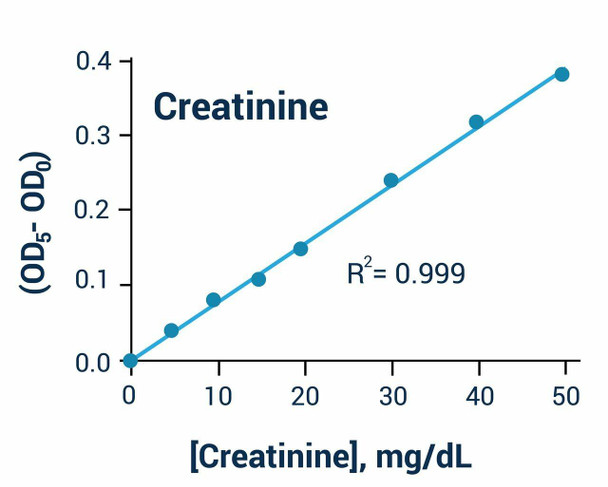
The Creatinine Assay Kit (SKU: BA0034) is designed to measure creatinine directly in biological samples without any pretreatment. Creatinine is synthesised at a fairly constant rate from creatine, removed by glomerular filtration and secreted into urine; its clearance is one of the most sensitive tests of glomerular filtration rate, and it is the most widely used marker of kidney function. In kidney disease, blood creatinine rises while the clearance rate and urine levels fall. This kit uses an improved Jaffe method in which picrate forms a red complex with creatinine; the intensity measured at 510 nm is directly proportional to the creatinine concentration. Separate blood and urine protocols are provided to cover the low and high concentration ranges. The kinetic, single working-reagent, five-minute procedure is readily automated and can be run in either 96-well plate or cuvette format.
| Product Name: | Creatinine Assay Kit (BA0034) |
| SKU: | BA0034 |
| Detection Method: | Colorimetric kinetic; improved Jaffe reaction with picrate measured at 510 nm |
| Detection Range: | Detection limit 0.10 mg/dL (8 µM); linear up to 50 mg/dL (blood) or 300 mg/dL (urine) |
| Sample Type: | Urine, serum, plasma, biological preparations |
| Species Reactivity: | All |
| Assay Time: | 5 min kinetic |
| Kit Size: | 500 Assays |
| Equipment Required: | Microplate reader |
| Storage: | Store Reagents A and B at 2-8°C and the Creatinine Standard at -20°C. |
| Shelf Life: | 12 months after receipt. |
| Shipping: | Room Temperature |
A colorimetric kinetic assay for the quantitative determination of creatinine directly in biological samples. The improved Jaffe method uses picrate, which forms a red complex with creatinine; the intensity measured at 510 nm is directly proportional to the creatinine concentration. Detection limit is 0.10 mg/dL (8 µM).
- Sensitive and accurate: uses 30 µL of sample; detection limit 0.10 mg/dL (8 µM) creatinine.
- Simple and high-throughput: a single working reagent and a 5-minute incubation; can be automated.
- Improved reagent stability and versatility: enhanced reagent and signal stability; 96-well plate or cuvette.
- Low interference in biological samples: no pretreatment required.
- Creatinine in urine, serum, plasma and biological preparations.
- Drug discovery and pharmacology: effects of drugs on creatinine metabolism.
Note: The below protocol is a sample protocol. Protocols are specific to each batch/lot. For the correct instructions please follow the protocol included in your kit.
| Step | Procedure |
| 1 | Equilibrate reagents to room temperature. Because the Jaffe reaction is kinetic, add Working Reagent quickly and mix briefly but thoroughly; a multi-channel pipettor is recommended. |
| 2 | Blood assay (low creatinine, linear up to 50 mg/dL): dilute standard to 2 mg/dL by mixing 5 µL 50 mg/dL stock with 120 µL dH2O. Transfer 30 µL diluted standard and serum/plasma in duplicate to a clear-bottom plate. Prepare Working Reagent by mixing equal volumes (>=100 µL each) of Reagent A and B; add 200 µL quickly. |
| 3 | Urine assay (high creatinine, linear up to 300 mg/dL): transfer 5 µL 50 mg/dL standard and urine in duplicate. Prepare Working Reagent by mixing 50 µL Reagent A, 50 µL Reagent B and 100 µL water; add 200 µL quickly. |
| 4 | Read optical density immediately (OD0) and again at 5 min (OD5) at 490-530 nm (peak absorbance at 510 nm). |
| 5 | Cuvette format: use 100 µL 2 mg/dL standard and serum/plasma (or 15 µL 50 mg/dL standard and 15 µL urine), add 1000 µL Working Reagent and read at 0 and 5 min. |
[Creatinine] = [(ODsample5 - ODsample0) / (ODSTD5 - ODSTD0)] x [STD] (mg/dL), where [STD] is 2 mg/dL for the blood assay and 50 mg/dL for the urine assay. Conversions: 1 mg/dL creatinine equals 88.4 µM, 0.001% or 10 ppm.
| Component | Quantity | Storage |
| Reagent A | 50 mL | 2-8°C |
| Reagent B | 50 mL | 2-8°C |
| Creatinine Standard (50 mg/dL) | 1 mL | -20°C |