D-Lactate Assay Kit - Information
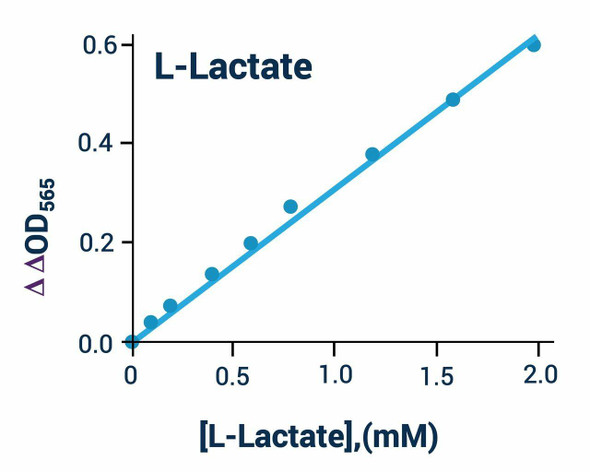
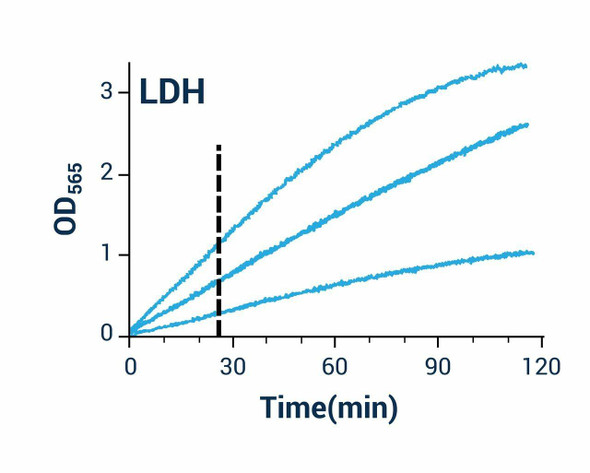
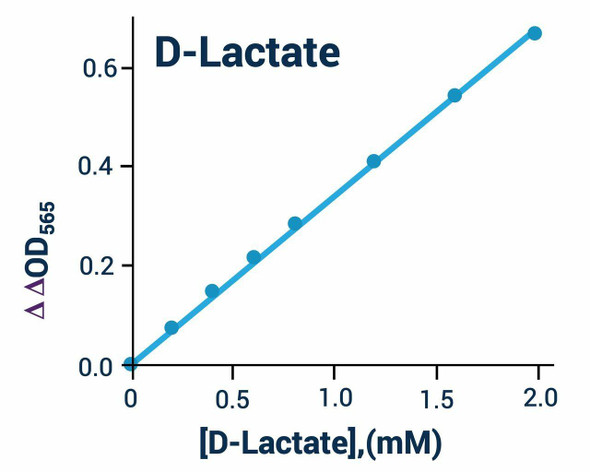
Assay Genie's Colorimetric D-lactate assay kit is based on lactate dehydrogenase catalyzed oxidation of lactate, in which the formed NADH reduces a formazan (MTT) Reagent. The intensity of the product color, measured at 565 nm, is proportionate to the lactate concentration in the sample.
Applications
For quantitative determination of D-lactate (D-lactic acid) and evaluation of drug effects on its metabolism.
D-Lactate Assay Kit - Key Features
- Sensitive and accurate. Detection limit of 0.05 mM and linearity up to 2 mM D-lactate in 96-well plate assay. For cell culture samples containing phenol red: detection limit of 0.1 mM and linearity up to 1 mM D-lactate in 96-well plate assay.
- Convenient. The procedure involves adding a single working reagent, and reading the optical density at time zero and at 20 min. Room temperature assay. No 37°C heater is needed.
- High-throughput. Can be readily automated as a high-throughput 96-well plate assay for thousands of samples per day.
D-Lactate Assay Kit - Data Sheet | |
| Kit Includes | Assay Buffer: 10 mL NAD Solution: 1 mL Enzyme A: 120 mL MTT Solution: 1.5 mL Enzyme B: 120 mL Standard: 1.0 mL 20 mM D-lactate |
| Kit Requires | Pipeting (multi-channel) devices. Clear-bottom 96-well plates and plate reader. |
| Method of Detection | OD565 nm |
| Detection Limit | 0.05 mM |
| Samples | Serum, plasma, cell culture media etc |
| Species | All |
| Protocol Length | 20 min |
| Size | 100 tests |
| Storage | Store all reagents at -20°C |
| Shelf Life | 6 months |
More Details
Lactate is generated by lactate dehydrogenase (LDH) under hypoxic or anaerobic conditions. Monitoring lactate levels is, therefore, a good indicator of the balance between tissue oxygen demand and utilization and is useful when studying cellular and animal physiology. D-lactate is produced in only minor quantities in animals and measuring for D-lactate in animal samples is a means to determine the presence of bacterial infection. Simple, direct and automation-ready procedures for measuring lactate concentration are very desirable.