Description
Urea Assay Kit (BA0050) (BA0050)
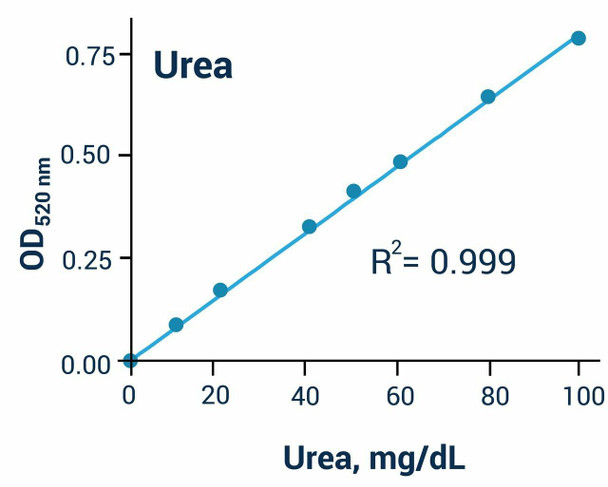
The Urea Assay Kit (SKU: BA0050) provides a simple, direct and automation-ready method for measuring urea or blood urea nitrogen directly in biological samples without any pretreatment. Urea is primarily produced in the liver and secreted by the kidneys and is the major end product of protein catabolism, serving as the primary vehicle for removal of toxic ammonia from the body. Urea determination is very useful for assessing kidney function, with raised levels associated with nephritis, renal ischaemia, urinary tract obstruction and certain extrarenal diseases, and reduced levels indicating acute hepatic insufficiency. The improved Jung method utilises a chromogenic reagent that forms a coloured complex specifically with urea, with the intensity of the colour, measured at 520nm, directly proportional to the urea concentration. Only 5 µL of sample is required, and the optimised formulation substantially reduces interference by substances in raw samples.
| Product Name: | Urea Assay Kit (BA0050) |
| SKU: | BA0050 |
| Detection Method: | Colorimetric |
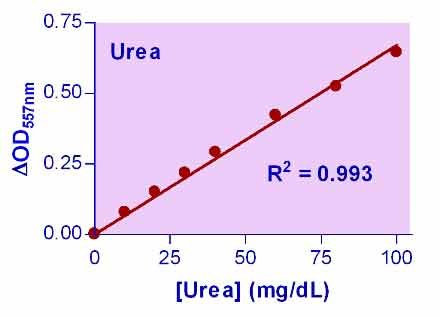
| Detection Range: | 0.08 mg/dL (13 µM) to 100 mg/dL (17 mM) urea in 96-well plate assay |
| Sample Type: | Serum, plasma, urine, milk, cell/tissue culture, bronchoalveolar lavage (BAL), waste water and soil |
| Species Reactivity: | All |
| Assay Time: | 20 minutes (50 minutes for low-urea samples) |
| Kit Size: | 100 Assays |
| Equipment Required: | Microplate reader |
| Storage: | The kit is shipped at room temperature. Store all components at 2-8°C. For long-term storage, keep standard at -20°C. |
| Shelf Life: | 12 months after receipt |
| Shipping: | Room Temperature |
This kit measures urea directly in biological samples without pretreatment. The improved Jung method utilises a chromogenic reagent that forms a coloured complex specifically with urea. The intensity of the colour, measured at 520nm, is directly proportional to the urea concentration in the sample.
- Sensitive and accurate: use 5 µL samples; linear detection range 0.08 mg/dL (13 µM) to 100 mg/dL (17 mM) urea in 96-well plate assay
- Simple and high-throughput: addition of a single working reagent and incubation for 20 minutes, readily automated for thousands of samples per day
- Improved reagent stability and versatility in cuvette or 96-well plate format
- Low interference in biological samples: no pretreatments required, assays performed directly on raw samples
- Direct assays: urea in serum, plasma, urine, milk, cell/tissue culture and bronchoalveolar lavage (BAL)
- Drug discovery/pharmacology: effects of drugs on urea metabolism
- Environment: urea determination in waste water, soil etc.
Note: The below protocol is a sample protocol. Protocols are specific to each batch/lot. For the correct instructions please follow the protocol included in your kit.
| Step | Procedure |
| 1 | Prepare Working Reagent by combining equal volumes of Reagent A and Reagent B shortly before assay; use within 20 minutes of mixing. |
| 2 | Serum and plasma can be assayed directly (n = 1); dilute urine 50-fold in distilled water (n = 50). Transfer 5 µL water (blank), 5 µL standard (50 mg/dL) and 5 µL samples in duplicate into wells. For low-urea samples (< 5 mg/dL), use 50 µL volumes with the 5 mg/dL standard. |
| 3 | Add 200 µL Working Reagent and tap lightly to mix. |
| 4 | Incubate 20 minutes (50 minutes for low-urea samples) at room temperature. |
| 5 | Read optical density at 520nm. For low-urea samples, read OD at 430nm. |
Urea concentration = [(ODSAMPLE − ODBLANK) / (ODSTANDARD − ODBLANK)] × n × [STD] (mg/dL), where n is the dilution factor and [STD] = 50 (or 5 for low-urea samples). Conversions: BUN (mg/dL) = [Urea] / 2.14; 1 mg/dL urea equals 167 µM, 0.001% or 10 ppm.
| Component | Quantity | Storage |
| Reagent A | 12 mL | 2-8°C |
| Reagent B | 12 mL | 2-8°C |
| Standard (50 mg/dL) | 0.5 mL | 2-8°C (long-term -20°C) |