Description
Ammonia Assay Kit II (BA0207) (BA0207)
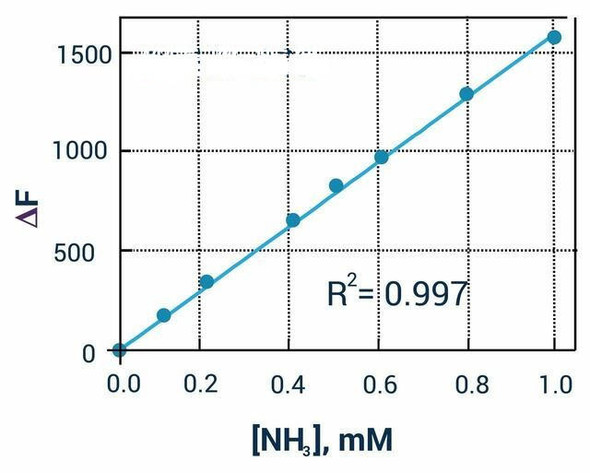
The Ammonia Assay Kit II (SKU: BA0207) offers a simple, fluorimetric method for the quantitative determination of ammonia and ammonium concentration in biological and environmental samples. The assay is based on an improved o-phthalaldehyde method in which the reagent reacts with ammonia and ammonium to form a fluorescent product, the intensity of which is directly proportional to the ammonia concentration in the sample. Fast and highly sensitive, it delivers a linear detection range of 0.005 to 2 mM ammonia with a detection limit of 5.3 uM. Supplied as a convenient single-component reagent, this homogeneous mix-incubate-measure assay is ideally suited to high-throughput work and can be readily automated on liquid-handling systems for processing thousands of samples per day. Fluorescence is measured at lambda ex/em = 415/475 nm on a standard microplate reader.
| Product Name: | Ammonia Assay Kit II (BA0207) |
| SKU: | BA0207 |
| Detection Method: | Fluorimetric (lambda ex/em = 415/475 nm) |
| Detection Range: | 0.005 - 2 mM ammonia (detection limit 5.3 uM) |
| Sample Type: | Urine, serum, plasma, environmental and other biological samples |
| Species Reactivity: | All |
| Assay Time: | 20 minutes |
| Kit Size: | 100 Assays |
| Equipment Required: | Microplate reader |
| Storage: | Shipped at room temperature. Store kit at -20 degrees C. |
| Shelf Life: | 6 months after receipt |
| Shipping: | Room Temperature |
Ammonia (NH3), or its ion form ammonium (NH4+), is an important source of nitrogen for living systems and is ubiquitously present in nature. Simple, direct and automation-ready procedures for measuring NH3 are highly desirable. This updated ammonia and ammonium assay is based on an improved o-phthalaldehyde method. This reagent reacts with ammonia and ammonium and forms a fluorescent product. The fluorescence intensity (lambda ex/em = 415/475 nm) is proportional to the ammonia concentration in the sample.
- Fast and sensitive with a linear detection range of 0.005 - 2 mM ammonia.
- Convenient and high-throughput using a single component reagent.
- Homogeneous mix-incubate-measure type assay.
- Can be readily automated on HTS liquid handling systems for processing thousands of samples per day.
- Ammonia and ammonium determination in biological samples such as urine, serum and plasma.
- Ammonia and ammonium determination in environmental samples.
Note: The below protocol is a sample protocol. Protocols are specific to each batch/lot. For the correct instructions please follow the protocol included in your kit.
| Step | Procedure |
| 1 | Use black flat-bottom 96-well plates and bring all reagents to room temperature prior to assay. |
| 2 | Prepare 200 uL of 1 mM Standard Premix by mixing 10 uL of 20 mM NH4Cl Standard and 190 uL of water. |
| 3 | Dilute the standards according to the standard dilution table to give 1.00, 0.50, 0.25 and 0 mM. |
| 4 | Transfer 10 uL of each standard into separate wells of the plate. |
| 5 | Transfer 10 uL of each sample into separate wells of the plate. |
| 6 | Add 90 uL of Detection Reagent to each well and immediately tap the plate to mix. |
| 7 | Incubate for 20 minutes in the dark at room temperature. |
| 8 | Measure fluorescence intensity at lambda ex/em = 415/475 nm on a plate reader. |
Plot the ammonia standard curve and determine its slope. The ammonia concentration of a sample is calculated as: [NH3] = (F_SAMPLE - F_BLANK) / Slope (mM), where F_SAMPLE and F_BLANK are the fluorescence intensity values of the sample and the blank (standard #4, water), respectively. If the ammonia concentration is higher than 2 mM, dilute the sample in water, repeat the assay and multiply the result by the dilution factor.
| Component | Quantity | Storage |
| Detection Reagent | 10 mL | -20 degrees C |
| Standard (NH4Cl) | 100 uL | -20 degrees C |