Description
Aspartate Transaminase (AST) Activity Assay Kit (BA0079) (BA0079)
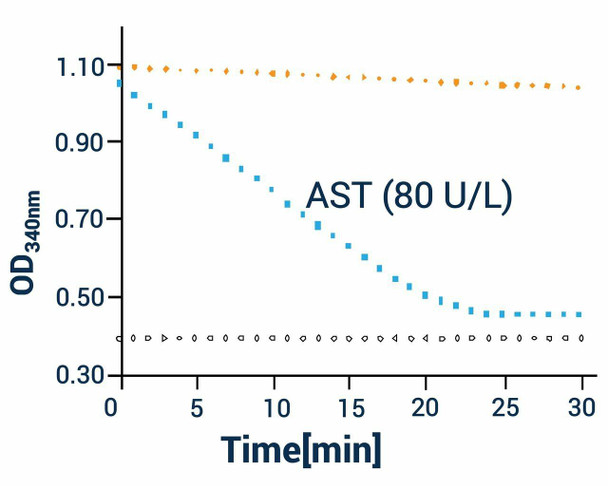
The Aspartate Transaminase (AST) Activity Assay Kit (SKU: BA0079) offers a simple, direct and automation-ready procedure for measuring AST activity in biological samples. Aspartate transaminase, also known as serum glutamic oxaloacetic transaminase (GOT) or aspartate aminotransferase, catalyses the conversion of aspartate and alpha-ketoglutarate to oxaloacetate and glutamate. AST is elevated in liver and muscle disorders and forms part of diagnostic panels for liver function, myocardial infarction and related conditions. In this assay, the oxaloacetate produced by AST and NADH are converted to malate and NAD by malate dehydrogenase, and the decrease in NADH absorbance at 340 nm is proportional to AST activity. The convenient assay can be run in a microplate or cuvette and takes only ten minutes.
| Product Name: | Aspartate Transaminase (AST) Activity Assay Kit (BA0079) |
| SKU: | BA0079 |
| Detection Method: | Colorimetric (kinetic) |
| Detection Range: | 2 to 100 U/L |
| Sample Type: | Serum and plasma (heparin, EDTA) |
| Species Reactivity: | All |
| Assay Time: | 10 minutes |
| Kit Size: | 100 Assays |
| Equipment Required: | Microplate reader |
| Storage: | -20C |
| Shelf Life: | 6 months after receipt, 3 weeks after reconstitution |
| Shipping: | Gel Pack |
Quantitative colorimetric determination of aspartate transaminase activity. Oxaloacetate produced by AST and NADH are converted to malate and NAD by malate dehydrogenase, and the decrease in NADH absorbance at 340 nm is proportional to AST activity.
- Sensitive, with a linear detection range of 2 to 100 U/L
- Simple and convenient; can be carried out in a microplate or a cuvette
- Rapid assay taking only 10 minutes
- Assays can be performed at 37C or at room temperature
- Direct assays of AST activity in serum, plasma and other biological samples
- Drug discovery and pharmacology: effects of drugs on AST activity
Note: The below protocol is a sample protocol. Protocols are specific to each batch/lot. For the correct instructions please follow the protocol included in your kit.
| Step | Procedure |
| 1 | Equilibrate all components to room temperature. Reconstitute the NADH Reagent tube with 1000 uL distilled water (final 10 mM); unused reconstituted NADH reagent is stable for three weeks when stored frozen at -20C. Mix the assay buffer well by vigorous shaking and keep thawed enzyme on ice. Assays can be performed at 37C or at room temperature; bring working reagents, microplate and spectrophotometer to the desired temperature. |
| 2 | Samples and controls (96-well plate). Transfer 20 uL sample to each well. For each assay plate, include two wells with 20 uL distilled water to serve as the NADH Standard and Blank, and keep the plate at the desired temperature. |
| 3 | Prepare Working Reagent for the sample and standard wells by mixing, per well, 200 uL Assay Buffer, 1 uL Cofactor, 1 uL Enzyme Mix and 4 uL NADH, and warm to the desired temperature. Prepare Blank Reagent for the blank well by mixing 200 uL Assay Buffer, 1 uL Cofactor, 1 uL Enzyme Mix and 4 uL distilled water. |
| 4 | Add 200 uL Working Reagent to the standard and sample wells and 200 uL Blank Reagent to the blank well. Immediately tap the plate to mix, incubate at the desired temperature and read OD340nm at 5 minutes and at 10 minutes, or alternatively record kinetics at 340 nm. |
| 5 | Cuvette procedure. For each sample and standard, prepare Working Reagent by mixing 1000 uL Assay Buffer, 5 uL Cofactor, 5 uL Enzyme Mix and 20 uL NADH; transfer 990 uL to each sample and standard cuvette. For the blank cuvette, add 960 uL Assay Buffer, 5 uL Cofactor, 5 uL Enzyme Mix and 20 uL distilled water. Warm to the desired temperature. |
| 6 | Prewarm the sample, add 100 uL sample to the sample cuvette and 100 uL water to the standard and blank cuvettes. Mix immediately and read OD340nm at 5 and 10 minutes, or record kinetics at 340 nm. |
For each sample, calculate the rate of NADH consumption by subtracting the OD at 10 min from the OD at 5 min (dODs). Similarly calculate the rate (dOD-NADH) for the NADH standard. AST activity (U/L) = [(dODs - dOD-NADH) / (OD-STD - OD-BLK)] x 388, where OD-STD and OD-BLK are the OD340nm values of the NADH standard and blank at 5 min. The factor 388 (uM/min) is derived from the NADH concentration, reaction volumes, sample dilution and reaction time. If the calculated activity is higher than 100 U/L, dilute the sample in Assay Buffer, repeat and multiply by the dilution factor. One unit (U) of AST catalyses the conversion of 1 umole of aspartate to oxaloacetate per minute at pH 8.1.
| Component | Quantity | Storage |
| Assay Buffer | 24 mL | -20C |
| Cofactor | 120 uL | -20C |
| Enzyme Mix | 120 uL | -20C |
| NADH Reagent | Dried | -20C |