Description
Isocitrate Assay Kit (Colorimetric) (BA0089) (BA0089)
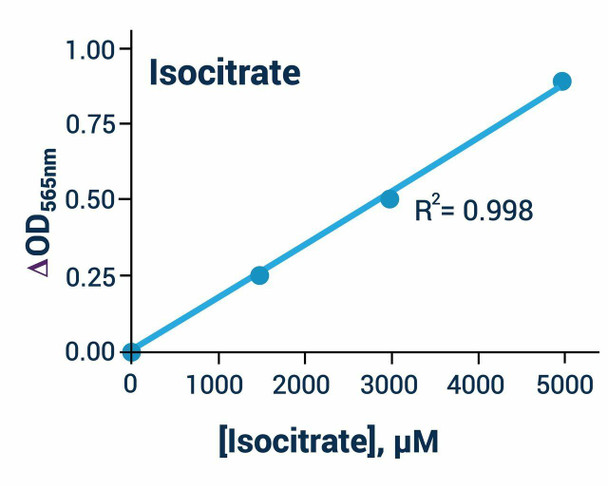
The Isocitrate Assay Kit (Colorimetric) (SKU: BA0089) provides a fast, sensitive and high-throughput procedure for measuring isocitrate. Isocitrate is a substrate in the citric acid cycle, formed by the isomerisation of citrate and oxidised by isocitrate dehydrogenase to produce alpha-ketoglutarate and NADPH; it is commonly found in fruits and vegetables and is used industrially as a marker of juice quality and purity. This assay measures the NADPH generated from the oxidation of isocitrate, which converts a dye to an intense violet colour with an absorption maximum at 565 nm. The increase in absorbance at 565 nm is directly proportional to the isocitrate concentration.
| Product Name: | Isocitrate Assay Kit (Colorimetric) (BA0089) |
| SKU: | BA0089 |
| Detection Method: | Colorimetric |
| Detection Range: | 20 to 5000 uM |
| Sample Type: | Food, beverage and biological samples (e.g. cell lysate, tissue homogenate, serum) |
| Species Reactivity: | All |
| Assay Time: | 10 minutes at room temperature |
| Kit Size: | 100 Assays |
| Equipment Required: | Microplate reader |
| Storage: | -20C |
| Shelf Life: | 6 months after receipt |
| Shipping: | Gel Pack |
Quantitative colorimetric determination of isocitrate. NADPH generated by isocitrate oxidation converts a dye to a violet product read at 565 nm; the absorbance is proportional to isocitrate concentration.
- Fast and sensitive; linear detection range 20 to 5000 uM with a 20 uL sample for a 10 minute reaction
- Convenient and high-throughput mix-incubate-measure format
- Readily automated on liquid handling systems
- Absorbance read at 565 nm
- Isocitrate determination in food, beverage and biological samples such as cell lysate, tissue homogenate and serum
Note: The below protocol is a sample protocol. Protocols are specific to each batch/lot. For the correct instructions please follow the protocol included in your kit.
| Step | Procedure |
| 1 | Sample preparation. For tissue, rinse in phosphate-buffered saline, homogenise 50 mg in about 200 uL 50 mM potassium phosphate (pH 7.5), centrifuge at 10,000 x g for 15 minutes at 4C and use the supernatant. For cell lysate, collect cells by centrifugation, homogenise or sonicate in cold 50 mM potassium phosphate (pH 7.5) and centrifuge at 14,000 x g for 10 minutes at 4C. Samples can be stored at -20 to -80C for at least one month. |
| 2 | Reagent preparation. Keep thawed Enzyme A and B on ice and equilibrate all other reagents to 25C; briefly centrifuge tubes before use. |
| 3 | Standards. Prepare 200 uL of 5000 uM premix by mixing 10 uL of the 100 mM standard and 190 uL distilled water, then dilute in centrifuge tubes as shown in the dilution table. Transfer 20 uL standards into separate wells of a clear flat-bottom 96-well plate. |
| 4 | Transfer 20 uL of each sample into separate wells. |
| 5 | Prepare enough working reagent by mixing, per well, 8 uL NADP/MTT solution, 1 uL Enzyme A, 1 uL Enzyme B and 75 uL Assay Buffer; fresh reconstitution is recommended. Add 80 uL working reagent to each sample well and tap briefly to mix. |
| 6 | Incubate at room temperature for 10 minutes and read OD565nm on a plate reader. |
Subtract the blank value (water, #4) from the standard values and plot dOD against standard concentrations to determine the slope. [Isocitrate] = (OD-sample - OD-blank) / slope x n (uM), where n is the sample dilution factor. Conversion: 1 uM is equivalent to 189 ug/L or 0.189 ppm isocitrate. If the calculated concentration exceeds 5000 uM, dilute the sample in water, repeat and multiply by the dilution factor.
| Component | Quantity | Storage |
| Assay Buffer | 10 mL | -20C |
| NADP/MTT | 1 mL | -20C |
| Standard | 1 mL | -20C |
| Enzyme A | 120 uL | -20C |
| Enzyme B | 120 uL | -20C |