Description
Oxalate Quick Test Strips (BA0264) (BA0264)
The Oxalate Quick Test Strips (SKU: BA0264) provide a rapid and inexpensive method for the direct determination of oxalate concentrations in biological samples. Oxalate, or oxalic acid, is a metabolic breakdown product of the Krebs cycle in eukaryotes and the glyoxylate cycle in other microorganisms, and is typically present in the urine of humans and other mammals, where its concentration can be used as a measure of kidney function. A high level of oxalate is an indicator for kidney stones, which are primarily made of the insoluble salt calcium oxalate, and measuring oxalate is more accurate than measuring calcium as a marker for kidney stones because calcium is excreted at high concentrations even in normal urine. The strips are based on the enzymatic oxidation of oxalate coupled with a colour reaction in one step, with the intensity of the product colour directly proportional to the oxalate concentration in the sample. Results are read within 5 minutes by comparison against a supplied colour chart. The strips are for research use only and should never be used for health-related decisions.
| Product Name: | Oxalate Quick Test Strips (BA0264) |
| SKU: | BA0264 |
| Detection Method: | Enzymatic colorimetric test strip (enzymatic oxidation of oxalate coupled with a colour reaction; visual colour chart comparison) |
| Sample Type: | ['Serum', 'Plasma', 'Urine'] |
| Species Reactivity: | All |
| Assay Time: | 5 minutes colour development |
| Kit Size: | 10 strips |
| Equipment Required: | Test strip (visual colour chart comparison) |
| Storage: | Refrigerator (4°C) |
| Shelf Life: | 6 months |
| Shipping: | Room Temperature |
Semi-quantitative enzymatic colorimetric test strips for the direct determination of oxalate in serum, plasma and treated urine samples using a visual colour-chart comparison.
- Rapid and inexpensive; requires no plate or cuvette readers.
- Based on enzymatic oxidation of oxalate coupled with a one-step colour reaction.
- Colour develops in around 5 minutes for straightforward visual comparison.
- Direct determination of oxalate concentrations in biological samples.
- Assessment of kidney function and screening for calcium-oxalate kidney stones.
Note: The below protocol is a sample protocol. Protocols are specific to each batch/lot. For the correct instructions please follow the protocol included in your kit.
| Step | Procedure |
| 1 | Sample preparation: whole blood samples are not compatible with the strips; most serum and plasma samples can be tested undiluted with no preparation. Urine samples require special treatment (see below). |
| 2 | Urine treatment: add 240 µL of urine and 10 µL 0.5 M EDTA to a tube containing 50 mg carbon powder. |
| 3 | Place the tube on a shaker for 5 minutes (or shake by hand if a shaker is unavailable). |
| 4 | Carefully add the sample to a 5 kDa cutoff filter and centrifuge for 2 minutes, reserving the effluent for testing. Alternatively, centrifuge the tube for 10 minutes, transfer the supernatant to a clean tube, centrifuge again for 5 minutes and reserve the supernatant. |
| 5 | Test procedure: carefully add 10 µL of sample directly to the strip reaction pad. |
| 6 | Let colour develop on the strip for 5 minutes. |
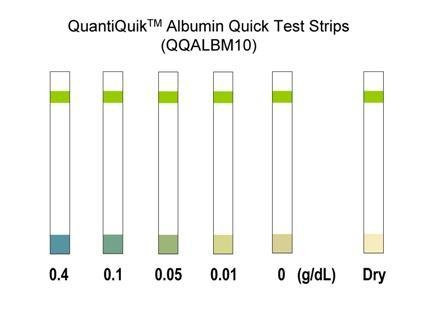
| 7 | Compare the colour of the reaction pad to the Oxalate Chart shown on the test strip bag; if the sample was diluted, multiply the chart concentration by the dilution used (e.g. 1.04 for urine) to determine the oxalate concentration in the sample. |
Oxalate concentration = concentration read from the Oxalate Chart × dilution factor used (e.g. 1.04 for treated urine samples).
| Component | Quantity | Storage |
| Test Strips | 10 | Refrigerator (4°C) |
| Instruction Manual | 1 | Room temperature |