Description
Beta-Glucosidase Activity Assay Kit (BA0018) (BA0018)
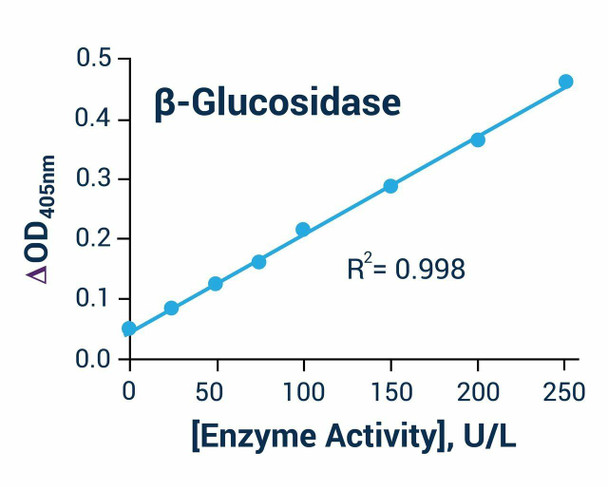
The Beta-Glucosidase Activity Assay Kit (SKU: BA0018) provides a colorimetric kinetic method for measuring beta-glucosidase activity directly in biological samples without pretreatment. Beta-glucosidase acts on the beta 1->4 bonds linking glucose or glucose-substituted molecules, and reduced activity of a lysosomal isoform has been linked to Gaucher's disease and Parkinson's disease. The improved method uses p-nitrophenyl-beta-D-glucopyranoside, which is hydrolysed specifically by beta-glucosidase into a yellow product with maximal absorbance at 405 nm, and the reaction rate is directly proportional to enzyme activity. Using only 20 µL of sample, the assay is linear from 2 to 250 U/L and delivers reliable results within 20 minutes. Its simple mix-and-measure format is fully compatible with high-throughput liquid handling instruments.
| Product Name: | Beta-Glucosidase Activity Assay Kit (BA0018) |
| SKU: | BA0018 |
| Detection Method: | Colorimetric kinetic (OD 405 nm) |
| Detection Range: | 2 to 250 U/L (20 µL sample); detection limit 2 U/L |
| Sample Type: | ['Biological samples', 'Enzyme preparations'] |
| Species Reactivity: | All |
| Assay Time: | 20 minutes |
| Kit Size: | 100 Assays |
| Equipment Required: | Microplate reader |
| Storage: | -20°C |
| Shelf Life: | 6 months after receipt |
| Shipping: | Room Temperature |
Beta-glucosidase is a glucosidase enzyme which acts upon beta 1->4 bonds linking two glucose or glucose-substituted molecules (i.e. the disaccharide cellobiose). Beta-glucosidases are required by organisms such as some fungi, bacteria and termites for the consumption of cellulose, and lysozyme is also a beta-glucosidase present in tears to prevent bacterial infection of the eye. In humans, lower activity of a beta-glucosidase isoform (lysosomal glucocerebrosidase) has been related to Gaucher's disease and Parkinson's disease. This kit is designed to measure beta-glucosidase activity directly in biological samples without pretreatment. The improved method utilises p-nitrophenyl-beta-D-glucopyranoside that is hydrolysed specifically by beta-glucosidase into a yellow coloured product (maximal absorbance at 405 nm). The rate of the reaction is directly proportional to the enzyme activity.
- High sensitivity and wide linear range. Use 20 µL sample. The detection limit is 2 U/L, linear up to 250 U/L.
- Homogeneous and simple procedure. Simple mix-and-measure procedure allows reliable quantitation of beta-glucosidase activity within 20 minutes.
- Robust and amenable to HTS. All reagents are compatible with high-throughput liquid handling instruments.
- Direct Assays: beta-glucosidase activity in biological samples.
- Characterisation and Quality Control for beta-glucosidase production.
- Drug Discovery: high-throughput screen for beta-glucosidase modulators.
Note: The below protocol is a sample protocol. Protocols are specific to each batch/lot. For the correct instructions please follow the protocol included in your kit.
| Step | Procedure |
| 1 | Equilibrate reagents to room temperature. Prepare the Working Solution by mixing, for each 96-well assay, 200 µL Assay Buffer and 8 µL beta-NPG substrate (final 1.0 mM); fresh reconstitution is recommended, although the Working Solution is stable for at least one day at room temperature. |
| 2 | Prepare samples in 50 mM phosphate (pH 7.0) buffer or another suitable enzyme buffer. Avoid chemicals known to affect activity, including SH-containing reagents (dithiothreitol, 2-mercaptoethanol, glutathione), Ca2+, Cu2+, Fe3+/Fe2+, Hg2+, Mg2+, Ni2+, Zn2+, SDS, EDTA and Tris. |
| 3 | Transfer 20 µL distilled water to two wells of a clear-bottom 96-well plate, adding 200 µL H2O to one well and 200 µL Calibrator to the other (total volume 220 µL). Transfer 20 µL samples into other wells and transfer 200 µL Working Reagent to the sample wells only (final reaction volume 220 µL), then tap the plate briefly to mix. |
| 4 | Read OD405nm at t = 0, and again after 20 min on a plate reader. |
Beta-Glucosidase Activity = [(OD20 - OD0) / (ODCalibrator - ODH2O)] x 250 (U/L), where OD20 and OD0 are OD405nm values of the sample at 20 and 0 min, and ODCalibrator and ODH2O are OD405nm values of the Calibrator and water at 20 min. Unit definition: one unit of enzyme catalyses the hydrolysis of 1 µmole of substrate per min at pH 7.0.
| Component | Quantity | Storage |
| Assay Buffer (pH 7.0) | 24 mL | -20°C |
| beta-NPG Substrate | 1 mL | -20°C |
| Calibrator (equivalent to 250 U/L) | 10 mL | -20°C |
| Gao et al. | α-bisabolol exerts anti-inflammatory action and ameliorates collagen-induced arthritis in rats | Indian Journal of Animal Research 2022 | View Citation |