Description
L-Lactate Assay Kit (Fluorometric) (BA0104) (BA0104)
The L-Lactate Assay Kit (Fluorometric) (SKU: BA0104) offers a simple, direct and automation-ready fluorometric method for measuring L-lactate. Lactate is generated by lactate dehydrogenase under hypoxic or anaerobic conditions, so monitoring its level is a useful indicator of the balance between tissue oxygen demand and utilisation in cellular and animal physiology. The assay is based on lactate dehydrogenase-catalysed oxidation of lactate, in which the NADH formed reduces a probe to a highly fluorescent product. The fluorescence intensity at 530/585 nm is proportional to the lactate concentration. The single-working-reagent, room-temperature procedure is well suited to high-throughput work.
| Product Name: | L-Lactate Assay Kit (Fluorometric) (BA0104) |
| SKU: | BA0104 |
| Detection Method: | Fluorometric (530/585 nm) |
| Detection Range: | 1 - 50 uM L-lactate (detection limit 1 uM) |
| Sample Type: | Serum, plasma, urine, cell culture media and other biological samples |
| Species Reactivity: | All |
| Assay Time: | 60 minutes |
| Kit Size: | 100 Assays |
| Equipment Required: | Microplate reader |
| Storage: | -20C |
| Shelf Life: | 6 months after receipt |
| Shipping: | Gel Pack |
A sensitive fluorometric assay for L-lactate across a wide range of biological samples. Serum and plasma should be diluted at least 200-fold; high-pyruvate samples require an internal standard.
- Sensitive and accurate with a detection limit of 1 uM and linearity up to 50 uM L-lactate
- Convenient single working reagent read after 60 minutes at room temperature
- High-throughput and readily automated
- Direct assay of L-lactate in serum, plasma, urine, cell media and other biological samples
Note: The below protocol is a sample protocol. Protocols are specific to each batch/lot. For the correct instructions please follow the protocol included in your kit.
| Step | Procedure |
| 1 | Standard Curve: prepare 1000 uL of 40 uM L-lactate Premix by mixing 2 uL of 20 mM Standard with 998 uL distilled water (or serum-free medium), then dilute per the table. Transfer 50 uL of each standard into a black 96-well plate. |
| 2 | Samples: add 50 uL of each sample to separate wells. Samples needing an internal standard require Sample plus Standard and Sample alone reactions plus a Water Blank; prepare 400 uL of 250 uM L-lactate from 5 uL of 20 mM Standard and 395 uL distilled water and add as directed. |
| 3 | Reagent Preparation: spin enzyme tubes briefly. For each Sample and Standard well, mix 40 uL Assay Buffer, 1 uL Enzyme A, 1 uL Enzyme B, 10 uL NAD and 5 uL Probe. |
| 4 | Reaction: add 50 uL Working Reagent per well quickly, tap to mix and incubate for 60 minutes at room temperature protected from light. |
| 5 | Read fluorescence at 530/585 nm. |
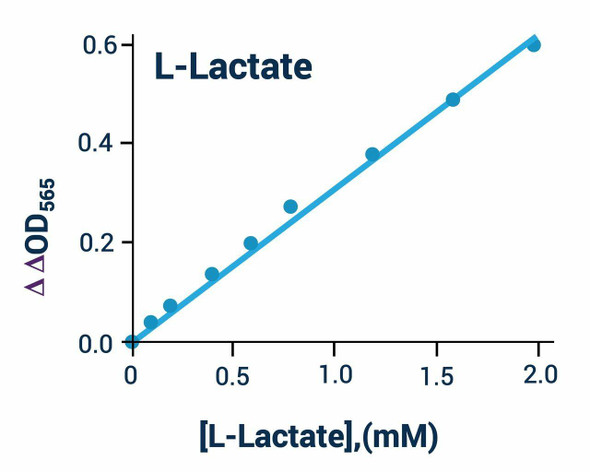
Plot the L-lactate standard curve and determine its slope. [L-Lactate] = (F_SAMPLE - F_BLANK) / Slope x n (uM), where n is the dilution factor (e.g. 200 for serum). With an internal standard, [L-Lactate] = (F_SAMPLE - F_BLANK) / (F_STANDARD - F_SAMPLE) x 27.8 (uM). If a reading exceeds the top standard or internal standard, dilute in water, repeat and multiply by the dilution factor.
| Component | Quantity | Storage |
| Assay Buffer | 10 mL | -20C |
| NAD Solution | 1 mL | -20C |
| Probe | 750 uL | -20C |
| Enzyme A | 120 uL | -20C |
| Enzyme B | 120 uL | -20C |
| Standard | 1 mL | -20C |