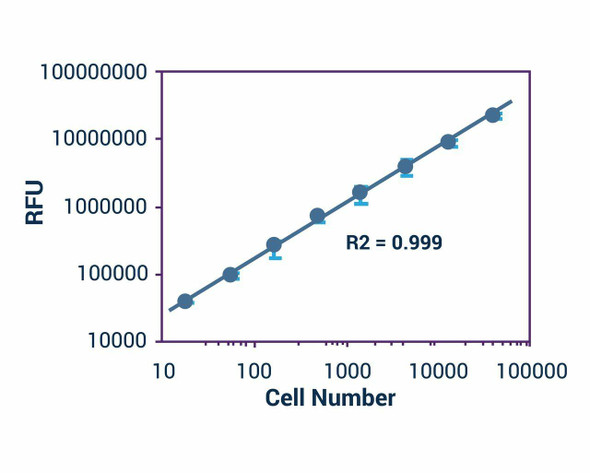
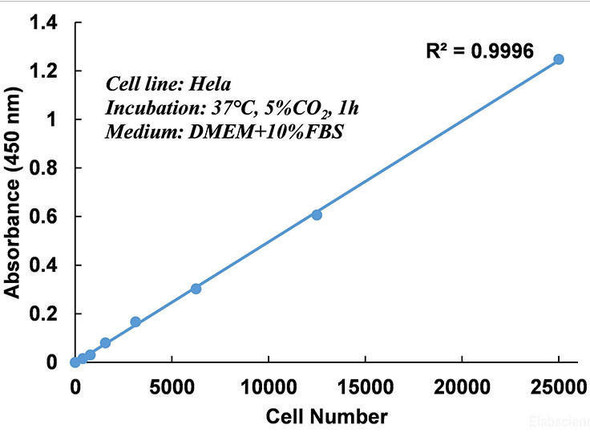
Description
MTT Cell Viability Assay (BA0004) (BA0004)
The MTT Cell Viability Assay (SKU: BA0004) provides a convenient, sensitive and reliable colorimetric method for determining the number of viable cells in culture. It is based on the conversion of the pale yellow tetrazolium salt MTT into purple formazan crystals by the pyridine nucleotide cofactors NADH and NADPH, a reaction catalysed only by living cells. Dissolving the resulting formazan with the supplied solubilisation buffer allows convenient quantification, with the colour intensity measured at 550-620 nm being directly proportional to the number of living cells. The reagents are optimised for sensitivity, assay robustness and automation. Applications include cell proliferation studies, cytotoxicity and apoptosis testing, and drug discovery.
| Product Name: | MTT Cell Viability Assay (BA0004) |
| SKU: | BA0004 |
| Detection Method: | Colorimetric (OD 570 nm) |
| Detection Range: | As low as 950 cells can be accurately quantified |
| Sample Type: | ['Adherent cells', 'Suspension cells', 'Cultured cells'] |
| Species Reactivity: | All |
| Assay Time: | ~5 hours (4 h incubation plus 1 h solubilisation) |
| Kit Size: | 500 Assays |
| Equipment Required: | Microplate reader |
| Storage: | Reagent at -20°C; Solubilisation Solution at room temperature |
| Shelf Life: | 12 months after receipt |
| Shipping: | Room Temperature |
The study of cell proliferation and cell viability requires accurate quantification of the number of viable cells in a culture. This homogeneous colorimetric assay is based on the conversion of the tetrazolium salt MTT, a pale yellow substrate, to formazan, a purple dye. This cellular reduction reaction involves the pyridine nucleotide cofactors NADH and NADPH and is catalysed only by living cells. The formazan product has low aqueous solubility and is present as purple crystals; dissolving the resulting formazan with a solubilisation buffer permits convenient quantification of product formation. The intensity of the product colour, measured at 550-620 nm, is directly proportional to the number of living cells in the culture. Reagents have been carefully formulated and optimised for sensitivity, assay robustness and automation.
- Safe. Non-radioactive assay.
- Sensitive and accurate. As low as 950 cells can be accurately quantified.
- Convenient and high-throughput. Mix-incubate-measure type assay with no wash or reagent transfer steps. Z' factors of 0.5 and above are observed, and it can be readily automated with HTS liquid handling systems.
- Cell Proliferation: effects of cytokines, growth factors and nutrients.
- Cytotoxicity and Apoptosis: evaluation of toxic compounds, anti-cancer antibodies, toxins and environmental pollutants.
- Drug Discovery: high-throughput screen for toxic and anticancer drugs.
Note: The below protocol is a sample protocol. Protocols are specific to each batch/lot. For the correct instructions please follow the protocol included in your kit.
| Step | Procedure |
| 1 | Plate and culture cells (80 µL per well) in clear-bottom 96-well tissue culture plates. Assays can be performed on adherent cells or cells in suspension, with cell numbers from 1,000 to 80,000 per well and volumes from 50 to 150 µL. Include control wells of culture medium containing no cells, or cells treated with a toxic reagent such as 0.1% saponin. |
| 2 | Add test compounds and controls (20 µL in PBS or culture medium) and incubate cells for the desired period of time, typically overnight, running assays in duplicate or triplicate. |
| 3 | Warm the Reagent to room temperature, add 15 µL (per 80 µL cell culture) of Reagent per well and incubate for 4 hours at 37°C. |
| 4 | Add 100 µL of the Solubilizer to each well and mix gently on an orbital shaker for one hour at room temperature. If precipitation occurs in the Solubilizer, warm the bottle in a warm water bath or at 37°C and shake to dissolve. |
| 5 | Measure OD570nm for each well on an absorbance plate reader. Maximum absorbance of the formazan dye lies between 560 and 590 nm. If desired the measurement can be performed the following day, sealing the plate to minimise evaporation. |
Determine the average of the blank controls and subtract this amount from all absorbance values. Plot the corrected absorbance at 570 nm against the concentration of the test compound and determine the EC50 (cell proliferation) or IC50 (cytotoxicity) by non-linear regression analysis.
| Component | Quantity | Storage |
| Reagent | 10 mL | -20°C |
| Solubilizer | 50 mL | Room temperature |