Description
Nitric Oxide Assay Kit (Colorimetric) (BA0007) (BA0007)
The Nitric Oxide Assay Kit (Colorimetric) (SKU: BA0007) provides a simple, accurate colorimetric method for quantifying nitric oxide production in biological samples. Because nitric oxide is rapidly oxidised to nitrite and nitrate, the assay measures total nitrite and nitrate as a surrogate measure of NO level using an improved Griess method with nitrate reduction. The optimised vanadium chloride reagent reduces nitrate to nitrite in just 10 minutes at 60°C, and the procedure can be completed in as little as 30 minutes. With a detection range of 0.6 to 100 µM in a 96-well plate, the assay is readily automated for high-throughput measurement of thousands of samples per day. It is suitable for the direct assay of NO in plasma, serum, urine, tissue, cells and foods, and for pharmacological studies of drugs affecting NO metabolism.
| Product Name: | Nitric Oxide Assay Kit (Colorimetric) (BA0007) |
| SKU: | BA0007 |
| Detection Method: | Colorimetric (OD 540 nm) |
| Detection Range: | 0.6 - 100 µM in 96-well plate |
| Sample Type: | ['Plasma', 'Serum', 'Urine', 'Saliva', 'Tissue', 'Cells', 'Foods'] |
| Species Reactivity: | All |
| Assay Time: | As short as 30 minutes |
| Kit Size: | 100 Assays |
| Equipment Required: | Microplate reader |
| Storage: | Standard at -20°C; all other reagents at -20 to 4°C |
| Shelf Life: | 6 months after receipt |
| Shipping: | Room Temperature |
Nitric oxide (NO) is a reactive radical that plays an important role in many key physiological functions. NO, an oxidation product of arginine by nitric oxide synthase, is involved in host defence and development, activation of regulatory proteins and direct covalent interaction with functional biomolecules. Since NO is oxidised to nitrite and nitrate, it is common practice to quantitate total nitrite/nitrate as a measure of NO level. This kit is designed to accurately measure NO production following reduction of nitrate to nitrite using an improved Griess method. The procedure is simple and the time required for sample pretreatment and assay is reduced to as short as 30 min.
- Sensitive and accurate. Detection range 0.6 - 100 µM in 96-well plate.
- Rapid and reliable. Using an optimised VCl3 reagent, the time required for reduction of nitrate to nitrite is 10 min at 60°C.
- Simple and high-throughput. The procedure involves mixing sample with three reagents, incubating 10 min at 60°C and reading the optical density. Can be readily automated to measure thousands of samples per day.
- Direct Assays: NO in plasma, serum, urine, tissue/cells and foods.
- Drug Discovery/Pharmacology: effects of drugs on NO metabolism.
Note: The below protocol is a sample protocol. Protocols are specific to each batch/lot. For the correct instructions please follow the protocol included in your kit.
| Step | Procedure |
| 1 | Prior to assay, equilibrate all components to room temperature. If precipitates are present in Reagent B, warm at 37°C until redissolved (approximately 10-15 min). |
| 2 | Prepare samples: homogenise tissue or cell samples in 1x PBS (pH 7.4) and centrifuge at 14,000 rpm at 4°C, using the supernatant. Samples requiring deproteination include serum, plasma, whole blood, FBS-containing culture media and tissue or cell lysates, whereas urine and saliva do not need deproteination. To deproteinate, mix 150 µL sample with 8 µL ZnSO4, vortex, add 8 µL NaOH, vortex again, centrifuge 10 min at 14,000 rpm and transfer 100 µL of the clear supernatant to a clean tube (treat 150 µL of each standard the same way to avoid a dilution factor). |
| 3 | Prepare standards: make 500 µL of 100 µM Premix by mixing 50 µL of 1.0 mM Standard and 450 µL distilled water, then dilute in 1.5 mL tubes as described in the standard curve table. |
| 4 | Add 100 µL of each Standard and Sample to separate labelled tubes (measure in at least duplicate). Immediately before starting, prepare enough Working Reagent by mixing per reaction tube 100 µL Reagent A, 4 µL Reagent B and 100 µL Reagent C. Add 200 µL of the Working Reagent to each tube and incubate for 10 min at 60°C (alternatively 60 min at 37°C or 150 min at room temperature). |
| 5 | Briefly centrifuge the reaction tubes to pellet any condensation, transfer 250 µL of each reaction to separate wells of a 96-well plate and read OD at 500-570 nm (peak 540 nm). |
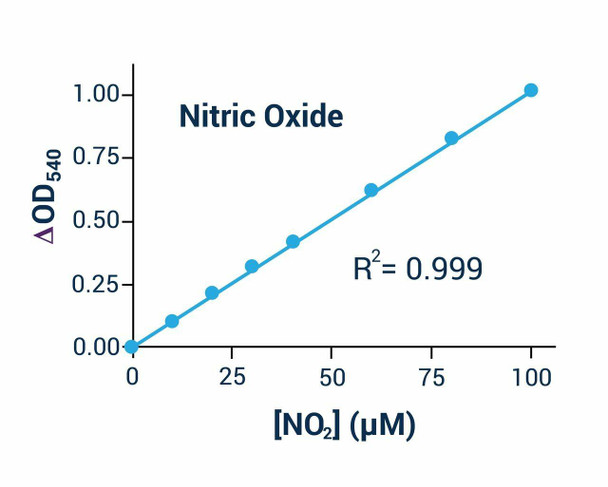
Subtract the blank OD (Standard 4) from the standard OD values and plot OD against standard concentrations. Determine the slope by linear regression. [Nitric Oxide] = [(ODSample - ODBlank) / Slope] x n (µM), where ODSample and ODBlank are optical density values of the sample and water and n is the dilution factor. If calculated nitric oxide exceeds 100 µM, dilute the sample in water, repeat and multiply by n. Conversions: 1 mg/dL NO equals 333 µM, 0.001% or 10 ppm.
| Component | Quantity | Storage |
| Reagent A | 12 mL | -20 to 4°C |
| Reagent B | 500 µL | -20 to 4°C |
| Reagent C | 12 mL | -20 to 4°C |
| NaOH | 1 mL | -20 to 4°C |
| ZnSO4 | 1 mL | -20 to 4°C |
| Standard | 1 mL | -20°C |