
High-Sensitivity ELISA Kits
Built for low-abundance proteins, cytokines and biomarkers in complex samples. Picogram-level detection limits, wide dynamic ranges and reproducible lot-to-lot performance let you quantify subtle changes in expression and validate biomarker discovery.
Up to 100× more sensitive than standard ELISA.
Intra- and inter-assay CV below 10%.
Serum, plasma, supernatant and tissue homogenate.
Validated kits across six species.
Standard 96-well plate workflow.
Lot-to-lot consistency for longitudinal studies.

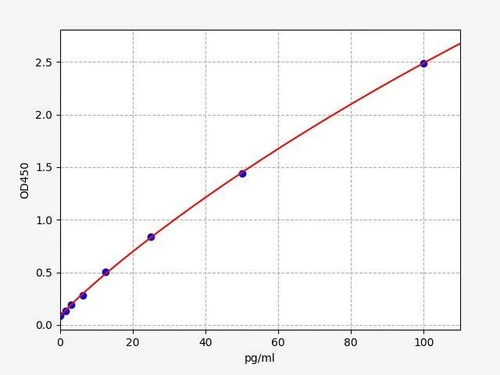
Representative standard curve: Human CRP ELISA Kit (High Sensitivity), HUES03393
The same sandwich workflow as a standard ELISA — the sensitivity gain comes from higher-affinity antibody pairs, an amplified detection step and standards calibrated across a lower range.
The immobilised capture antibody binds the analyte from your sample or standard.
A biotinylated detection antibody binds a second epitope, forming the sandwich.
Streptavidin–HRP delivers multiple enzymes per analyte, boosting low signal.
TMB develops colour; stop and read at 450 nm against the standard curve.
0.3 pg/mL · sandwich
View kit →
1.88 pg/mL · sandwich
View kit →
PharmaGenie · sandwich
View kit →
PharmaGenie · sandwich
View kit →
0.47 pg/mL · sandwich
View kit →
0.09 ng/mL · sandwich
View kit →
18.75 pg/mL · competitive
View kit →
1.88 pg/mL · sandwich
View kit →
Cytokines, chemokines & inflammatory markers

Tumour biomarkers, growth factors & more

Hormones, adipokines, metabolic regulators

Neurotrophic factors, neuroinflammation biomarkers

Vascular markers & adhesion molecules

Immune response mediators
Need faster results or several analytes at once? See fast ELISA kits or multiplex ELISA.
A high-sensitivity ELISA reaches a lower limit of detection than a standard kit for the same analyte — typically single-digit picograms per millilitre rather than tens or hundreds. That comes from higher-affinity matched antibody pairs, an amplified detection step (biotin–streptavidin–HRP rather than a directly conjugated antibody), and a standard curve calibrated across a lower concentration range.
It depends on the analyte. The most sensitive kits in the range reach around 0.19 pg/mL, and many sit between 0.3 and 5 pg/mL. Each product page lists the kit's own sensitivity and detection range — check them against the concentrations you expect in your samples before ordering.
Most kits are validated in serum, plasma, cell-culture supernatant, cell lysate, tissue homogenate and other biological fluids. Validated matrices are listed per kit, because a kit validated in serum will not necessarily perform identically in urine or CSF without a matrix check.
Use a high-sensitivity kit when your expected concentration is at or below the standard kit's lower limit of quantification, when sample volume is limited, or when you need to resolve small fold-changes near baseline. If your analyte is abundant, a standard kit gives a wider upper range and fewer dilution steps.
Yes — several kits are supplied in a small-sample-volume format for cases where only a few microlitres of serum or plasma are available, such as serial bleeds in mouse studies. They are listed alongside the standard-format kits below.
Intra- and inter-assay coefficients of variation are held below 10%, and each batch is checked for lot-to-lot consistency so results stay comparable across timepoints and studies.
Tell us your target, species and expected concentration range and our PhD-level team will point you to the closest assay or scope a custom ELISA.