

What Is FAAH? Fatty Acid Amide Hydrolase and the Endocannabinoid System
What is FAAH?
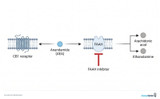
FAAH stands for fatty acid amide hydrolase, the enzyme that breaks down anandamide and related fatty-acid amide signalling lipids. By hydrolysing anandamide, one of the body's own cannabinoids (endocannabinoids), to arachidonic acid, FAAH switches off its signal [1, 2]. Human FAAH (also called FAAH-1) is a 579-amino-acid membrane enzyme of about 63 kDa, encoded on chromosome 1p33 [8, 10]. Because blocking it raises anandamide levels, FAAH has been proposed as a drug target for pain and neuropsychiatric disorders [2].
Key takeaways
- FAAH was cloned in 1996 as the enzyme that degrades the sleep-inducing lipid oleamide. It was shown to hydrolyse anandamide as well [1].
- Mice lacking FAAH have about 15-fold higher brain anandamide and reduced pain sensation, reversed by a CB1 blocker [2].
- A common human variant, 385C>A (Pro129Thr), makes FAAH more prone to degradation and has been associated with problem drug use [4].
- FAAH inhibitors have had mixed clinical results: PF-04457845 failed in knee osteoarthritis pain, and BIA 10-2474 caused a severe neurological disorder in a phase 1 trial [6, 7].
What FAAH does
Many signalling molecules are paired with an enzyme that ends their action quickly; acetylcholine has acetylcholinesterase, for example. Cravatt and colleagues identified FAAH as that enzyme for fatty-acid amides. They first isolated it as "oleamide hydrolase" from rat liver membranes, then showed it also converts anandamide to arachidonic acid, and renamed it to reflect its range of substrates [1].
According to UniProt, FAAH hydrolyses [10]:
- anandamide, which it prefers over monounsaturated substrates;
- oleamide and other fatty amides;
- to a lesser extent, the second endocannabinoid 2-arachidonoylglycerol (2-AG).
FAAH belongs to the amidase signature family of serine hydrolases. Its 2.8 Å crystal structure showed how, unlike soluble members of the same family, it sits in the membrane with its active site opening directly into the lipid bilayer, where its substrates are found [3].
The FAAH knockout mouse established its role in the body. FAAH−/− mice could barely degrade anandamide. When given anandamide, they showed strong CB1-dependent responses: reduced movement, analgesia, catalepsy and hypothermia. Their own brain anandamide was about 15-fold higher, and their reduced pain sensitivity was reversed by the CB1 antagonist SR141716A [2]. FAAH therefore sets the endocannabinoid "tone" that modulates pain perception.

FAAH-1 and FAAH-2
Humans have a second enzyme, FAAH-2, which shares only about 20% sequence identity with FAAH-1 [9]:
- Both hydrolyse primary fatty acid amides such as oleamide at similar rates.
- FAAH-1 is much more active on N-acyl ethanolamines such as anandamide.
- The FAAH-2 gene is present in primates but absent from mouse and rat.
That last point matters when comparing rodent and human data. It also matters for reagents: specify FAAH-1 (gene FAAH, UniProt O00519) or FAAH-2 explicitly. UniProt also lists "FAAH" as an alternative name for the unrelated fatty acid 2-hydroxylase FA2H, so check the accession when searching [10].
FAAH genetics: P129T and FAAH-OUT
P129T. The single-nucleotide polymorphism 385C>A changes a conserved proline to threonine (Pro129Thr). The variant enzyme has normal catalytic properties but is broken down more easily by proteases. In homozygous form it was strongly associated with street drug use and problem drug or alcohol use [4].
FAAH-OUT. In 2019, researchers described a woman with lifelong pain insensitivity and quickly healing injuries who needed no pain relief after hand surgery. She carried two changes [5]:
- a microdeletion in FAAH-OUT, a pseudogene and long non-coding RNA next to FAAH;
- a common FAAH variant with reduced expression and activity.
Her circulating anandamide, palmitoylethanolamide and oleoylethanolamine were all raised, consistent with loss of FAAH function [5].
FAAH inhibitors in the clinic
Two clinical studies shaped how FAAH inhibitors are seen.
- PF-04457845, a potent, selective, irreversible FAAH-1 inhibitor, raised endocannabinoid levels but did not relieve pain in patients with knee osteoarthritis [6].
- BIA 10-2474, an oral reversible FAAH inhibitor, caused an acute, rapidly progressive neurological syndrome at the highest dose (50 mg/day) of a 2016 phase 1 trial. Three of four reported participants were affected and one became brain dead. The mechanism of this toxicity remains unknown [7].
How to measure FAAH
- Protein level: a sandwich ELISA kit quantifies FAAH in tissue homogenates and cell lysates. Because FAAH is membrane-bound [3, 10], use a lysis buffer that solubilises membranes.
- Western blot: expect a band near the predicted 63 kDa [10]. For FAAH-2, use a FAAH-2-specific antibody: the two enzymes share only about 20% identity [9].
- Activity: a fluorometric FAAH activity assay, together with measurement of the lipid substrates (anandamide, oleamide, PEA and OEA), reports on function. Measuring both protein and activity helps interpret variants such as P129T, which lowers the enzyme's stability without changing its catalytic properties [4].
- Species: mouse and rat lack FAAH-2, so rodent FAAH-1 data do not capture all human fatty-amide hydrolysis [9].
Related products
- Human FAAH (Fatty-acid amide hydrolase 1) ELISA Kit (AEFI01111)
- Mouse FAAH (Fatty Acid Amide Hydrolase) ELISA Kit (AEKE02752)
- Fatty Acid Amide Hydrolase (FAAH) Activity Fluorometric Assay Kit (MAES0323)
- FAAH1 Rabbit Monoclonal Antibody (CAB4099)
- FAAH2 Rabbit Polyclonal Antibody (CAB18554)
- Human FAAH Recombinant Protein (N-His) (GXRP13289)
FAQ
What is the full form of FAAH?
Fatty acid amide hydrolase [1].
What does FAAH break down?
Mainly anandamide and other fatty-acid amides such as oleamide. It can also hydrolyse 2-AG [1, 10].
What happens when FAAH is inhibited or missing?
Anandamide levels rise. In mice this reduces pain sensitivity through CB1 receptors [2], and in a person with FAAH and FAAH-OUT mutations it was linked to pain insensitivity [5].
References
- Cravatt BF, et al. Molecular characterization of an enzyme that degrades neuromodulatory fatty-acid amides. Nature. 1996;384:83–7. doi:10.1038/384083a0
- Cravatt BF, et al. Supersensitivity to anandamide and enhanced endogenous cannabinoid signaling in mice lacking fatty acid amide hydrolase. Proc Natl Acad Sci USA. 2001;98:9371–6. doi:10.1073/pnas.161191698
- Bracey MH, Hanson MA, Masuda KR, Stevens RC, Cravatt BF. Structural adaptations in a membrane enzyme that terminates endocannabinoid signaling. Science. 2002;298:1793–6. doi:10.1126/science.1076535
- Sipe JC, Chiang K, Gerber AL, Beutler E, Cravatt BF. A missense mutation in human fatty acid amide hydrolase associated with problem drug use. Proc Natl Acad Sci USA. 2002;99:8394–9. doi:10.1073/pnas.082235799
- Habib AM, et al. Microdeletion in a FAAH pseudogene identified in a patient with high anandamide concentrations and pain insensitivity. Br J Anaesth. 2019;123:e249–53. doi:10.1016/j.bja.2019.02.019
- Huggins JP, Smart TS, Langman S, Taylor L, Young T. An efficient randomised, placebo-controlled clinical trial with the irreversible fatty acid amide hydrolase-1 inhibitor PF-04457845, which modulates endocannabinoids but fails to induce effective analgesia in patients with pain due to osteoarthritis of the knee. Pain. 2012;153:1837–46. doi:10.1016/j.pain.2012.04.020
- Kerbrat A, et al. Acute neurologic disorder from an inhibitor of fatty acid amide hydrolase. N Engl J Med. 2016;375:1717–25. doi:10.1056/NEJMoa1604221
- NCBI Gene 2166: FAAH. ncbi.nlm.nih.gov/gene/2166
- Wei BQ, Mikkelsen TS, McKinney MK, Lander ES, Cravatt BF. A second fatty acid amide hydrolase with variable distribution among placental mammals. J Biol Chem. 2006;281:36569–78. doi:10.1074/jbc.M606646200
- UniProt O00519: FAAH1_HUMAN. uniprot.org/uniprotkb/O00519
Recent Posts
-
Rat SOD1 ELISA Kit (RTFI00215) in Diabetes, PCOS, Epilepsy
SummaryThe Rat SOD1/Superoxide dismutase 1 ELISA Kit (RTFI00215) is a double-antibody sandwich ELI …25th Nov 2026 -
What Is FAAH? Fatty Acid Amide Hydrolase and the Endocannabinoid System
What is FAAH? FAAH stands for fatty acid amide hydrolase, the enzyme that breaks down anandamide a …25th Nov 2026 -
BOLA1: A Mitochondrial BolA Protein in Iron–Sulfur and Redox Biology
What is BOLA1? BOLA1 (bolA family member 1) is a small human mitochondrial protein of 137 amino ac …25th Nov 2026