
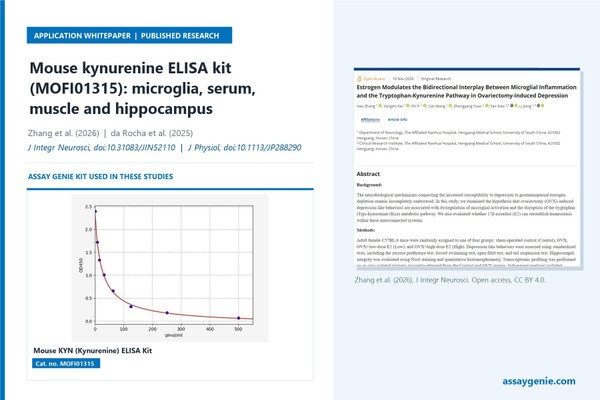
Mouse Kynurenine ELISA Kit (MOFI01315): Published Uses

Summary
Assay Genie's Mouse KYN (Kynurenine) ELISA Kit (MOFI01315) is a competitive ELISA that has been used to measure kynurenine in two published mouse studies. Zhang et al. (2026) measured kynurenine in microglia-enriched hippocampal cells from ovariectomised (OVX) mice, where it rose and was lowered again by 17β-estradiol (E2). da Rocha et al. (2025) measured kynurenine in serum, gastrocnemius and hippocampus after exhaustive exercise and expressed it as kynurenine/tryptophan and related ratios.
Key takeaways
- MOFI01315 quantified kynurenine in microglia-enriched cell lysates [1] and in serum, hippocampus and gastrocnemius homogenates [2].
- In OVX mice, kynurenine was significantly higher than in controls (p < 0.001), and E2 reversed the increase dose-dependently [1].
- Immediately after acute exhaustive exercise, the hippocampal KYN/TRP ratio rose while gastrocnemius KYN/TRP and KYN/KYNA fell [2].
- da Rocha et al. measured tryptophan and kynurenic acid with other vendors' kits, so their ratios combine two suppliers' calibrations.
Product cited in these studies

Mouse KYN (Kynurenine) ELISA Kit (MOFI01315)
Used by Zhang et al. (2026) in microglia-enriched hippocampal lysates and by da Rocha et al. (2025) in serum, hippocampus and gastrocnemius.
View kit →At a glance
| Study | Model / species | Sample type | Product | What it measured | Key role in study |
|---|---|---|---|---|---|
| Zhang et al., 2026, J Integr Neurosci [1] | Female C57BL/6 mice, 10–12 weeks; control (sham), OVX, OVX + low E2, OVX + high E2 | Lysates of Percoll-isolated, microglia-enriched hippocampal cells (n = 6, per Fig. 5 legend) | Mouse KYN ELISA Kit (MOFI01315) | Kynurenine level, reported per group | Metabolic evidence that oestrogen loss shifts microglial tryptophan metabolism towards kynurenine, and that E2 reverses it |
| da Rocha et al., 2025, J Physiol [2] | Male C57BL/6 mice, 8 weeks; acute exhaustive exercise, 8-week overtraining, SR9009 (REV-ERB-α agonist) | Serum; hippocampus and gastrocnemius homogenates loaded at equal protein (n = 4–6 per group, per figure legends) | Mouse KYN ELISA Kit (MOFI01315) | Kynurenine, expressed as KYN/TRP and KYN/KYNA ratios | Metabolite readout linking muscle REV-ERB-α and KAT1/KMO changes to kynurenine handling in muscle, blood and brain |
Why measure kynurenine?
Tryptophan is an essential amino acid. A small fraction is converted by tryptophan hydroxylase (TPH2 in the brain) to serotonin, but most is degraded through the kynurenine pathway. The first, rate-limiting step is catalysed by indoleamine 2,3-dioxygenase 1 (IDO1) or tryptophan 2,3-dioxygenase, and its product is kynurenine. IDO1 is induced by pro-inflammatory cytokines, so inflammation can divert tryptophan away from serotonin and towards kynurenine.
Kynurenine sits at a branch point. Kynurenine aminotransferases such as KAT1 (gene KYAT1) convert it to kynurenic acid (KYNA), which is generally regarded as neuroprotective. Kynurenine 3-monooxygenase (KMO) routes it towards 3-hydroxykynurenine and quinolinic acid, which can be neurotoxic. da Rocha et al. point out that KYNA does not cross the blood–brain barrier, whereas kynurenine can enter the brain, so the way peripheral tissues handle kynurenine may matter for the central nervous system [2].
Kynurenine on its own is therefore an informative but partial readout. Read alongside tryptophan from the same samples, it indicates pathway flux; adding KYNA shows which branch kynurenine is entering. Both studies below measured tryptophan as well, with separate kits.

How the product was used
Zhang et al. (2026): oestrogen, microglial inflammation and the tryptophan–kynurenine pathway
Research question. The authors asked whether depression-like behaviour after OVX is linked to microglial NF-κB p65 inflammation and a shift of tryptophan metabolism towards the kynurenine pathway, and whether E2 reverses these changes [1]. OVX removes the main source of ovarian oestrogen, so giving E2 back tests which changes depend on oestrogen.
Experimental design. Adult female C57BL/6 mice (10–12 weeks) underwent bilateral OVX or sham surgery under isoflurane anaesthesia. After a four-week recovery, OVX mice received corn-oil vehicle or subcutaneous E2 at 1.0 or 5.0 µg/mouse/day for four weeks. Behaviour was assessed by sucrose preference, open field, forced swim and tail suspension tests.
Samples. Primary microglia were isolated from the hippocampi on a Percoll gradient (cells resuspended in 30% Percoll and layered over a 70% cushion). The authors state that no antibody-based purification was performed, so the cells were a microglia-enriched population, typically above 80% Iba1+ by cytospin. The cells were lysed in cold PBS with a protease inhibitor cocktail and centrifuged, and the supernatant was taken for analysis. Two reporting points need care: the Methods describe isolating microglia from separate Control and OVX cohorts, yet Fig. 5 also shows E2 groups, and the Results describe the tryptophan change as hippocampal while the Fig. 5 legend refers to primary microglia.
Assay workflow as reported. Kynurenine was quantified in these lysates with the Assay Genie Mouse KYN ELISA kit (MOFI01315) “according to the manufacturer’s protocol” [1]. Samples were run in duplicate and read on a microplate reader. By ELISA the authors also measured tryptophan with the Assay Genie Mouse Trp ELISA kit (AEKE03090), 5-HT and 5-HIAA with other vendors' kits, and TNF-α, IL-1β and IL-6 with R&D Systems kits. Groups were compared by one-way ANOVA with Tukey's post hoc test. The paper does not describe a normalisation step (for example, to total protein), does not state concentration units in the text and does not report a kynurenine/tryptophan ratio.
How the readout supported the conclusion. Kynurenine was significantly higher in the OVX group than in controls (p < 0.001), and E2 reversed the increase dose-dependently (low dose p = 0.007; high dose p < 0.001). Tryptophan moved in the opposite direction. The authors set the kynurenine rise beside other OVX findings: higher IDO1 and MAO-A protein, lower TPH2, SERT and 5-HT, more iNOS+ Iba1+ microglia and more nuclear phospho-NF-κB p65 (Ser468). They read this as oestrogen deficiency linking microglial inflammation to tryptophan diversion. They also acknowledge that the design is correlational and that no in vitro E2 experiments were done on microglia.
da Rocha et al. (2025): exhaustive exercise, REV-ERB-α and the kynurenine pathway
Research question. The authors asked whether exhaustive exercise disrupts the circadian transcriptional repressor REV-ERB-α (gene NR1D1) in skeletal muscle, and whether this is linked to kynurenine-pathway changes in muscle, blood and brain that might help explain exercise-induced fatigue [2].
Experimental design. Eight-week-old male C57BL/6 mice were used; the authors chose males only to avoid confounding by the oestrous cycle. After treadmill adaptation, an incremental load test set running intensity. In the acute experiment, mice ran downhill (−14% incline) at 60% of the test velocity until exhaustion, starting between 6.00 and 7.00 p.m., and tissues were collected immediately and 6, 12 and 18 h later. In the chronic experiment, mice followed an 8-week overtraining protocol, with tissues collected every 6 h from the start of the dark cycle (ZT12). A further in vivo experiment gave SR9009 intraperitoneally twice daily for three days. C2C12 myoblasts with REV-ERB-α knockout or overexpression were studied in parallel by immunoblotting.
Samples. Mice were anaesthetised and decapitated, and blood was centrifuged to obtain serum. Hippocampus and gastrocnemius were snap-frozen, later homogenised in PBS and centrifuged at 5000 g, and supernatant protein was measured by BCA. The authors state that equal amounts of protein and serum were used across samples.
Assay workflow as reported. The authors list “MOFI01315 (Kynurenine) from Assay Genie (Dublin, Ireland)” among the kits used [2]; kynurenic acid and tryptophan were measured with MyBioSource ELISA kits, all according to the manufacturers' protocols. Kynurenine data were presented as percentage changes in KYN/TRP and KYN/KYNA ratios (alongside KYNA/TRP) against controls, not as absolute concentrations. Data are mean ± SD; groups were compared by unpaired t test or two-way ANOVA with Tukey's test.
How the readout supported the conclusion. Immediately after acute exhaustive exercise, the KYN/TRP ratio rose in the hippocampus (P = 0.028) but fell in gastrocnemius (P = 0.048), where KYN/KYNA also fell (P = 0.008). In serum, KYNA/TRP fell (P = 0.031) and KYN/KYNA tended to rise (P = 0.060). Overtraining did not change serum ratios at ZT12. SR9009 raised serum KYN/TRP (P = 0.007). The authors combined these ratios with lower KAT1 protein in muscle and hippocampus and changes in KMO to argue that exhaustive exercise pushes kynurenine metabolism towards the neurotoxic branch. Downstream metabolites (3-hydroxykynurenine, quinolinic acid, picolinic acid) were not measured; the authors list them as future work.

Cross-study insights
- Matrices. MOFI01315 was used on microglia-enriched cell lysates [1] and on serum plus hippocampus and gastrocnemius homogenates [2]. Both are mouse matrices, but they differ in protein content and background, so each needs its own sample preparation.
- Single values versus ratios. Zhang et al. reported kynurenine per group; da Rocha et al. reported only ratios. Ratios built from different kits (here, MOFI01315 with other vendors' tryptophan and KYNA kits) depend on each kit's calibration, so they are best compared within a study rather than between studies.
- Normalisation. da Rocha et al. loaded equal protein after BCA; Zhang et al. did not describe normalisation. Reporting this step makes lysate and homogenate data easier to interpret and reproduce.
- Sex, hormones and timing. One study used females with altered oestrogen status, the other used males sampled at fixed times after exercise or across the light–dark cycle. Both hormonal status and sampling time are worth recording in kynurenine work.
- Hippocampal readouts. Both studies reported a hippocampal change: higher kynurenine in microglia-enriched cells [1] and a higher KYN/TRP ratio in hippocampal tissue immediately after acute exhaustive exercise [2].
Practical considerations for mouse kynurenine ELISA
Generic best practice, not reported by either study:
- Pair with tryptophan. Measure tryptophan in the same aliquot so that a within-sample kynurenine/tryptophan ratio can be calculated.
- Normalise lysates and homogenates. Express concentrations per mg total protein or per cell number, and state the units.
- Control pre-analytical variables. Keep samples cold, avoid repeated freeze–thaw cycles and keep dissection-to-freezing time consistent across groups.
- Match collection times. Tryptophan metabolism can vary with time of day and feeding, so sample all groups at matched times.
- Check the matrix. Run a dilution-linearity or spike-recovery test on pooled sample first; see the product page for validated sample types and the assay range.
- Consider orthogonal confirmation. LC-MS/MS can confirm key comparisons and add downstream metabolites.
Measuring kynurenine in mouse samples?
The Mouse KYN (Kynurenine) ELISA Kit cited in these studies is available from Assay Genie, with expert technical support.
View the Mouse KYN ELISA Kit →Frequently asked questions
What does a high kynurenine-to-tryptophan ratio mean?
A raised kynurenine/tryptophan ratio means more tryptophan is being converted to kynurenine, which is usually read as increased IDO1 or TDO activity. Inflammatory cytokines such as IFN-γ and TNF-α induce IDO1, so the ratio is widely used as a marker of immune activation in depression, infection, exercise and cancer research.
Can kynurenine be measured by ELISA instead of LC-MS?
Yes. A competitive kynurenine ELISA quantifies kynurenine with a standard plate reader and suits many samples at once. LC-MS/MS measures several pathway metabolites in one run and is often used to confirm key findings. ELISA works well for targeted group comparisons, ideally with tryptophan measured in the same samples.
Why link the kynurenine pathway to depression?
When inflammation induces IDO1, more tryptophan goes to kynurenine and less is available for serotonin synthesis. Some downstream metabolites, such as quinolinic acid and 3-hydroxykynurenine, are neurotoxic. Together, lower serotonin and neurotoxic metabolites are proposed to contribute to inflammation-associated depression in both animal models and patients.
Why measure kynurenine in exercise studies?
Skeletal muscle can convert kynurenine to kynurenic acid, which does not cross the blood–brain barrier, so muscle can influence how much kynurenine reaches the brain. Measuring kynurenine in serum, muscle and brain, ideally with tryptophan and kynurenic acid, shows whether exercise shifts the pathway towards neuroprotective or neurotoxic branches.
Which samples can be used with the Mouse KYN ELISA Kit (MOFI01315)?
The product page lists serum, plasma, cell culture supernatant, cell or tissue lysate and other liquids, with a stated range of 7.813–500 pmol/mL. In published work it has been used on microglia-enriched cell lysates, serum, and hippocampus and gastrocnemius homogenates. Validate any new matrix before a full study.
References
- Zhang H, Xie Y, Yi Y, Wang C, Yuan Z, Xiao F, Jiang L. Estrogen modulates the bidirectional interplay between microglial inflammation and the tryptophan-kynurenine pathway in ovariectomy-induced depression. Journal of Integrative Neuroscience. 2026;25(11):52110. doi:10.31083/JIN52110.
- da Rocha AL, Pinto AP, de Sousa Neto IV, Muñoz VR, et al. Exhaustive exercise abolishes REV-ERB-α circadian rhythm and shifts the kynurenine pathway to a neurotoxic profile in mice. The Journal of Physiology. 2025;603:3923–3944. doi:10.1113/JP288290.
Recent Posts
-
Mouse Kynurenine ELISA Kit (MOFI01315): Published Uses
SummaryAssay Genie's Mouse KYN (Kynurenine) ELISA Kit (MOFI01315) is a competitive ELISA that has …22nd Nov 2026 -
IL-6 ELISA Kit: 14 Studies in Rat, Mouse and Human Samples
SummaryAssay Genie IL-6 sandwich ELISA kits, and one sandwich chemiluminescent immunoassay (CLIA) …21st Nov 2026 -
Fatty Acid Oxidation Assay Kit: 20 Published Applications
SummaryThe Assay Genie Fatty Acid Oxidation (FAO) Assay Kit (BR00001) is a colorimetric plate-rea …20th Nov 2026