
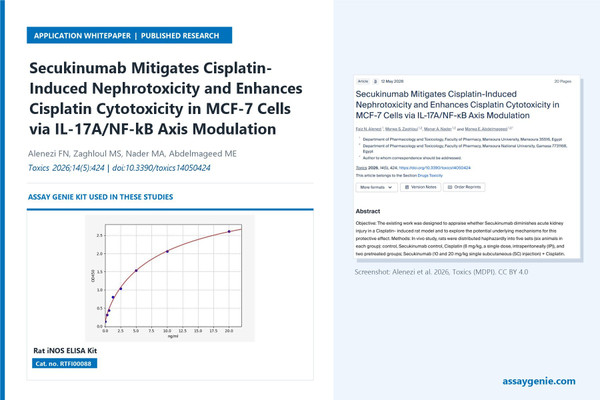
Rat iNOS ELISA Kit (RTFI00088) in Toxic Organ Injury Models

Summary
Assay Genie's Rat iNOS/Nitric oxide synthase, inducible ELISA Kit (RTFI00088) is a sandwich ELISA that three published rat studies used to quantify inducible nitric oxide synthase (iNOS) protein in tissue. Alenezi et al. (2026) measured iNOS in kidney homogenate after cisplatin with or without secukinumab, Alharbi et al. (2025) measured it in testicular homogenate after tacrolimus with or without agmatine, and Abdelmageed et al. (2021) reported pancreatic iNOS in L-arginine-induced acute pancreatitis treated with protocatechuic acid. The kit measures the amount of iNOS protein, not nitric oxide (NO) or enzyme activity.
Key takeaways
- RTFI00088 measured iNOS in rat tissue: kidney [1], testis [2] and pancreas [3].
- iNOS was higher after cisplatin and tacrolimus and lower with the treatment under test [1, 2]; the pancreatitis abstract reports that treatment normalised pancreatic iNOS [3].
- The kit is a sandwich ELISA for iNOS protein. It does not measure NO or enzyme activity, although two papers describe the readout as iNOS activity.
- All three papers come from one research group at Mansoura University, and one was read from its abstract only [3].
Product cited in these studies
Rat iNOS/Nitric oxide synthase, inducible ELISA Kit (RTFI00088)
Used on kidney, testis and pancreas in three published rat studies.
View kit →At a glance
| Study | Model / species | Sample type | Product | What it measured | Key role in study |
|---|---|---|---|---|---|
| Alenezi et al., 2026, Toxics [1] | Male Wistar rats; single cisplatin dose (8 mg/kg i.p.) ± secukinumab (10 or 20 mg/kg s.c.); 5 groups | Right-kidney homogenate (10% w/v in PBS) | Rat iNOS ELISA Kit (RTFI00088) | Renal iNOS, with MDA, total antioxidant capacity and injury markers | Nitrosative-stress arm of the IL-17A/NF-κB mechanism |
| Alharbi et al., 2025, Pharmaceutics [2] | Male Wistar rats; tacrolimus (5 mg/kg/day i.p.) ± agmatine (10 or 40 mg/kg/day oral) for 14 days; 6 groups of 6 | Right-testis homogenate (10% w/v in PBS) | RTFI00088 (catalogue number printed for iNOS) | Testicular iNOS, alongside MDA, GSH, HO-1, SIRT1, Bcl-2 and IL-17 | Supported agmatine's proposed iNOS-lowering, antioxidant action |
| Abdelmageed et al., 2021, Eur J Pharmacol [3] | Rats; L-arginine-induced acute pancreatitis ± protocatechuic acid (50 or 100 mg/kg oral, 10 days) | Pancreas (preparation: methods detail not accessible) | RTFI00088 (supplier printed as “Reagent Genie”) | Pancreatic iNOS, reported with NO | Part of the oxidant/antioxidant and HMGB1/TLR4/NF-κB readout |
Why measure iNOS in rat tissue?
Inducible nitric oxide synthase (iNOS, encoded by Nos2) is one of three NOS isoforms that convert L-arginine to L-citrulline and nitric oxide. Unlike the constitutive neuronal and endothelial enzymes, iNOS is barely detectable in most resting tissues. It is induced transcriptionally by inflammatory signals such as bacterial lipopolysaccharide, TNF-α, IL-1β and interferon-γ, largely through NF-κB, and its activity does not depend on calcium. Once expressed, it produces NO in large amounts for long periods.
At high flux, NO reacts with superoxide to form peroxynitrite, which nitrates tyrosine residues, damages lipids and DNA, and contributes to what is often called nitrosative stress. For this reason iNOS is a common marker of inflammatory tissue injury, and it is usually reported alongside lipid peroxidation (MDA), antioxidant defences and NF-κB-linked cytokines.
Three different measurements are easily conflated. An iNOS ELISA such as RTFI00088 measures immunoreactive iNOS protein. NO itself is short-lived and is usually estimated as nitrite or nitrite plus nitrate (for example by the Griess reaction). Enzyme activity requires a separate assay, such as conversion of labelled arginine to citrulline. A rise in iNOS protein suggests, but does not prove, greater NO production.

How the product was used
Alenezi et al. (2026): secukinumab in cisplatin nephrotoxicity
Research question. The authors asked whether secukinumab, an anti-IL-17A monoclonal antibody, reduces acute kidney injury in a cisplatin rat model, through which mechanisms, and whether it changes the cytotoxicity of cisplatin in MCF-7 breast cancer cells [1].
Experimental design. Adult male Wistar rats (12–14 weeks, 200–250 g) were assigned to five groups: control, secukinumab 20 mg/kg alone, cisplatin, and cisplatin with secukinumab at 10 or 20 mg/kg. Cisplatin was given once (8 mg/kg i.p.), and secukinumab was given once subcutaneously 2 h beforehand. Rats were sampled 3 days after cisplatin. The Methods state n = 6 per group, while several figure and table legends give n = 5. Endpoints included serum creatinine, BUN and LDH, renal KIM-1 and NGAL, histology, MDA and total antioxidant capacity, and renal p38 MAPK, phospho-NF-κB p65, IL-6, SIRT1, AMPKα1, Beclin-1 and p62. IL-17A itself was not measured in vivo.
Samples. The right kidney was frozen at −80 °C in PBS (10% w/v) and later homogenised, and the left kidney was fixed for histology. Centrifugation of the homogenate and protein normalisation are not described.
Assay workflow as reported. In the ELISA section of the Methods, iNOS, AMPKα1 and Beclin-1 were determined in kidney homogenates with commercial ELISA kits, with iNOS listed as “Cat no: RTFI00088, Assay Genie, Dublin 2, Ireland” [1]. Data were tested for normality and analysed by one-way ANOVA with Tukey–Kramer post hoc tests (or Kruskal–Wallis for non-parametric data).
How the readout supported the conclusion. Renal iNOS was higher in cisplatin-treated rats than in controls, and pre-treatment with secukinumab 20 mg/kg improved the oxidant/antioxidant changes, iNOS included. The paper does not report an iNOS comparison for the 10 mg/kg dose. The Results text describes the change as iNOS activity, although the assay measures iNOS protein. In the Discussion, the authors grouped iNOS with MDA as markers of nitrosative and oxidative stress reduced by secukinumab and linked them to IL-17A/NF-κB control of pro-oxidant mediators.
Alharbi et al. (2025): agmatine and tacrolimus-induced testicular injury
Research question. The authors examined whether agmatine protects against testicular toxicity caused by the calcineurin inhibitor tacrolimus in rats [2].
Experimental design. Thirty-six male Wistar rats (200–250 g, about 7–8 weeks old) were divided into six groups of six: control, agmatine 10 or 40 mg/kg/day alone, tacrolimus (5 mg/kg/day i.p.), and tacrolimus with agmatine 10 or 40 mg/kg/day (oral), given together for 14 days. Endpoints included sperm count and viability, serum testosterone and LH, testicular histology and morphometry, oxidative stress, Nrf2, NF-κB, caspase-3 and the panel below.
Samples. Testes were rinsed in ice-cold saline, blotted and weighed. The right testis was homogenised in PBS (10% w/v); the left was fixed in Bouin's solution. Homogenate centrifugation, storage and protein normalisation are not described.
Assay workflow as reported. Section 2.7 lists Bcl-2, IL-17, HO-1, SIRT1 and iNOS, each with supplier and catalogue number, measured in testicular homogenate as the manufacturers instructed. The iNOS entry reads “Assay Genie, Duplin, Ireland, RTFI00088” (the city is misspelt in the paper) [2]. The section does not name the assay format; the product page identifies RTFI00088 as a sandwich ELISA. MDA and GSH were measured with Biodiagnostic assay kits (Giza, Egypt), and NO or nitrite was not measured. Groups were compared by one-way ANOVA with Tukey–Kramer post hoc testing (p < 0.05).
How the readout supported the conclusion. Tacrolimus raised testicular iNOS above control, and both agmatine doses lowered it relative to tacrolimus alone, with a larger effect at 40 mg/kg (Figure 3C of the paper). In the Discussion, the authors described agmatine as an iNOS inhibitor and cited lower MDA and iNOS with higher GSH as evidence of reduced oxidative stress. Their conclusions centre on Nrf2/HO-1, SIRT1 and NF-κB. Because only iNOS protein was measured, the proposed fall in NO and peroxynitrite was inferred rather than measured.
Abdelmageed et al. (2021): protocatechuic acid in L-arginine acute pancreatitis
Abstract and sheet evidence only; methods detail not accessible (subscription article).
Research question. The authors tested whether protocatechuic acid, a natural phenolic acid, protects rats against L-arginine-induced acute pancreatitis and the accompanying liver, lung and kidney injury [3].
Experimental design. According to the abstract, rats received protocatechuic acid orally at 50 or 100 mg/kg for 10 days before intraperitoneal L-arginine. Endpoints included histology of the pancreas, liver, lungs and kidneys, pancreatic enzymes, liver and kidney function markers, oxidant/antioxidant status, and pancreatic HMGB1, TLR4, MyD88, NF-κB, TNF-α, IL-1β and IL-6.
Samples and assay workflow. The abstract reports iNOS in the pancreas. A short text excerpt from the paper names an “ELISA kit for rats (Reagent Genie, Ireland, Cat. no. RTFI00088)” [3], and Assay Genie's product page lists this paper among the citations of RTFI00088. Tissue preparation, normalisation and statistics: methods detail not accessible.
How the readout supported the conclusion. The abstract states that protocatechuic acid normalised pancreatic iNOS and NO levels. With the oxidant/antioxidant markers, this formed the antioxidant side of a conclusion that named HMGB1/TLR4/NF-κB as the main protective pathway.

Cross-study insights
- Same research group. All three papers come from the Department of Pharmacology and Toxicology, Faculty of Pharmacy, Mansoura University, Egypt, and share at least one author (Nader MA). The consistent use of RTFI00088 reflects one group's practice, not independent replication across laboratories.
- Matrix. All uses were in tissue: kidney [1], testis [2] and pancreas [3]. Neither full-text study used serum or plasma for iNOS, although both are listed sample types on the product page.
- Preparation. Both full-text studies homogenised one organ at 10% w/v in PBS and kept the contralateral organ for histology [1, 2]. Neither describes centrifugation, protease inhibitors or protein normalisation, which makes absolute values hard to compare between studies.
- Protein versus activity. Both full-text papers sometimes describe the readout as iNOS activity [1, 2]. The kit measures protein. Only the pancreatitis study reports NO alongside iNOS [3]; pairing iNOS protein with a nitrite/nitrate assay gives a stronger case for changed NO output.
- Panel design. In every study iNOS was read within a larger oxidative-stress and NF-κB-related panel and was not a primary endpoint.
Practical considerations for rat iNOS ELISA in tissue
These are general good-practice points, not steps reported by the studies. Follow the protocol supplied with your kit lot.
- Follow the kit's homogenate protocol. The product page advises homogenising tissue in PBS with protease inhibitors, centrifuging and collecting the supernatant. iNOS is an intracellular protein, so complete homogenisation matters.
- Normalise. Measure total protein in the same supernatant and express iNOS per mg protein, or record tissue weight and buffer volume.
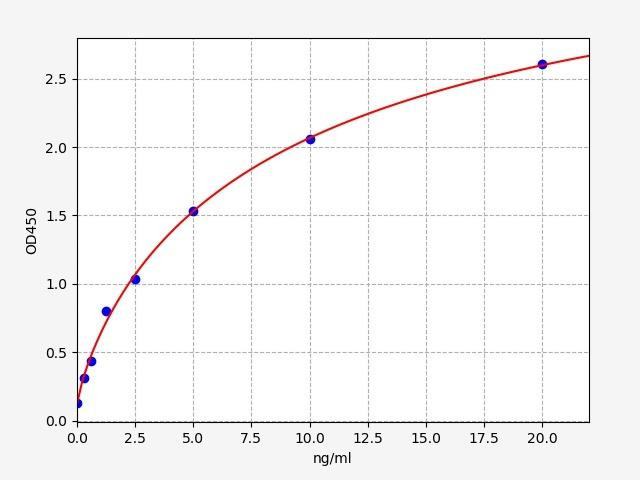
- Check the range. The RTFI00088 product page gives a range of 0.313–20 ng/mL and a sensitivity of 0.188 ng/mL. Basal iNOS is low in healthy tissue, so pilot dilutions on both control and injured samples.
- Store and handle consistently. Aliquot supernatants, store frozen and avoid repeated freeze–thaw cycles; run all groups on the same plate where possible.
- Validate the matrix. The page reports linearity and recovery for serum and plasma only; run spike-recovery and dilution-linearity checks on pooled tissue homogenate.
- Add a functional readout. Measure nitrite/nitrate if the conclusion concerns NO production.
Measuring iNOS in rat samples?
The Rat iNOS ELISA Kit cited in these studies is available from Assay Genie, with expert technical support.
View the Rat iNOS ELISA Kit →Frequently asked questions
What does the Rat iNOS ELISA Kit (RTFI00088) measure?
It measures iNOS protein in rat samples by double-antibody sandwich ELISA. The product page lists a sensitivity of 0.188 ng/mL, a range of 0.313–20 ng/mL and a 450 nm read, with serum, plasma, cell culture supernatant, cell or tissue lysate and other liquid samples as sample types. Published studies used it on kidney, testis and pancreas.
Does an iNOS ELISA measure nitric oxide or iNOS activity?
No. An ELISA detects the amount of iNOS protein. NO is usually estimated as nitrite or nitrate (for example by the Griess reaction), and enzyme activity needs a separate assay such as arginine-to-citrulline conversion. Higher iNOS protein suggests greater capacity for NO production, so pair the two readouts when NO output is the question.
Why does iNOS rise in cisplatin nephrotoxicity?
Cisplatin injures tubular cells and triggers NF-κB-driven inflammation, which induces iNOS and favours nitrosative stress. Alenezi et al. (2026) reported higher renal iNOS three days after cisplatin in rats, and lower levels with secukinumab 20 mg/kg pre-treatment, which the authors linked to IL-17A/NF-κB modulation.
Is iNOS involved in drug-induced testicular injury?
In the tacrolimus rat model studied by Alharbi et al. (2025), testicular iNOS rose with tacrolimus and fell with agmatine, more at 40 than 10 mg/kg/day. The authors read this with MDA and GSH as evidence of reduced oxidative stress. NO itself was not measured, so the NO link was inferred.
How should rat tissue be prepared for an iNOS ELISA?
The product page advises homogenising tissue in PBS with protease inhibitors, centrifuging and using the supernatant. The two full-text studies homogenised kidney or testis at 10% w/v in PBS. Measure total protein in the same supernatant for normalisation, aliquot, avoid freeze–thaw cycles and keep samples within the kit's 0.313–20 ng/mL range.
References
- Alenezi FN, et al. Secukinumab mitigates cisplatin-induced nephrotoxicity and enhances cisplatin cytotoxicity in MCF-7 cells via IL-17A/NF-κB axis modulation. Toxics. 2026;14(5):424. doi:10.3390/toxics14050424.
- Alharbi N, et al. Agmatine abrogates tacrolimus-induced testicular injury in rats. Pharmaceutics. 2025;17(6):703. doi:10.3390/pharmaceutics17060703.
- Abdelmageed ME, et al. Targeting HMGB1/TLR4/NF-κB signaling pathway by protocatechuic acid protects against l-arginine induced acute pancreatitis and multiple organs injury in rats. European Journal of Pharmacology. 2021;906:174279. doi:10.1016/j.ejphar.2021.174279.
Recent Posts
-
Rat IL-6 ELISA Kit (RTFI00034) in Colon Carcinogenesis
SummaryAssay Genie's Rat IL-6 ELISA Kit (RTFI00034) is a double-antibody sandwich ELISA for rat in …27th Nov 2026 -
Rat iNOS ELISA Kit (RTFI00088) in Toxic Organ Injury Models
SummaryAssay Genie's Rat iNOS/Nitric oxide synthase, inducible ELISA Kit (RTFI00088) is a sandwich …27th Nov 2026 -
Rat GSH ELISA Kit (RTEB1811) in Diabetes and Brain Research
SummaryAssay Genie's Rat Glutathione (GSH) ELISA Kit (RTEB1811) is a competitive ELISA that three …27th Nov 2026