
CXXC Domain Proteins: What CXXC1 (CFP1) Does at CpG Islands
What is a CXXC domain?
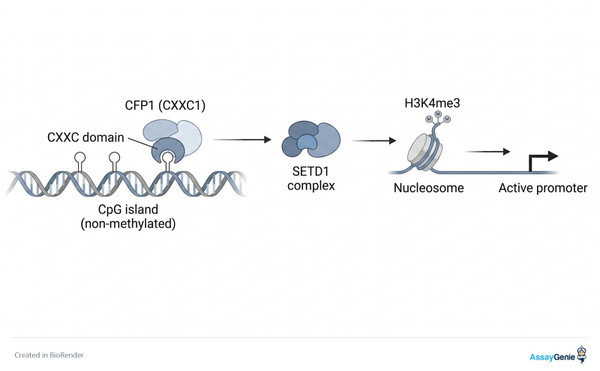
A CXXC domain is a small zinc-finger module named after its repeated cysteine–X–X–cysteine motifs, and it recognises CpG dinucleotides in DNA only when they are not methylated. The best-studied example is CXXC finger protein 1 (CXXC1), also called CFP1 or CpG-binding protein (CGBP). It binds the non-methylated CpG islands that sit at most human gene promoters and recruits the SETD1 complex, which places the active-promoter mark histone H3 lysine 4 trimethylation (H3K4me3) [1–4].
Key takeaways
- CXXC domains bind unmethylated CpG; methylating the CpG or mutating it abolishes binding [1, 3].
- CXXC1 is a 656-amino-acid nuclear protein (predicted 75.7 kDa) encoded on chromosome 18q21.1. Native protein runs at about 88 kDa on Western blots [1, 8].
- Cfp1 is highly enriched at non-methylated CpG islands, and depleting it markedly reduces H3K4me3 there [2].
- Mice lacking the gene die around implantation [5].
The CXXC motif and the CXXC protein family
The CXXC zinc finger was first recognised as a shared cysteine-rich domain in DNA methyltransferase 1 (DNMT1), the trithorax-family methyltransferase MLL and methyl-CpG-binding domain protein 1 (MBD1). In 2000, Voo and colleagues cloned human CGBP, now CXXC1, and showed that its CXXC domain is enough to bind a single CpG site [1].
The same domain occurs in a small family of chromatin regulators. Besides CXXC1, the family includes MLL1 and MLL2, the lysine demethylases KDM2A and KDM2B, the DNA demethylases TET1 and TET3, FBXL19, and the smaller CXXC4 and CXXC5 proteins. Each uses the CXXC domain to bring a different enzymatic activity to non-methylated CpG islands [4].
Crystal structures of the CFP1 CXXC domain bound to DNA show how it reads CpG [3]:
- The crescent-shaped domain wedges into the DNA major groove.
- A rigid three-residue loop holds the CpG and leaves no room for a methyl group, which is why only non-methylated CpG is accepted.
- CFP1 also prefers a guanine immediately after the CpG, the "CpGG" preference recorded in UniProt.
What CXXC1 (CFP1) does
Beyond the CXXC domain, CXXC1 has two plant homeodomain (PHD)-like cysteine-rich domains. It is expressed ubiquitously and activates promoters that contain CpG motifs, but not promoters where the CpG has been removed [1].
Its main job is to link CpG-island DNA to histone modification:
- In mouse brain, Cfp1-bound chromatin closely matched non-methylated CpG islands and H3K4me3 peaks [2].
- Depleting Cfp1 markedly reduced H3K4me3 at CpG islands [2].
- Artificial CpG clusters inserted into the genome without any promoter still recruited Cfp1 and created new H3K4me3 peaks [2].
CFP1 is an essential component of the SETD1 H3K4 methyltransferase complex [3]. Live-cell imaging and genomics showed that it targets SET1 to actively transcribed promoters by reading two signals at once: non-methylated DNA and existing H3K4me3. In the absence of CFP1, SET1 loses its normal placement and gene expression is disturbed [6].

The protein is needed early in development. Mice lacking CGBP produced no viable offspring, and mutant embryos were already absent by 6.5 days post-coitum. Their blastocysts could still hatch and form an inner cell mass in culture [5]. In the nucleus, CXXC1 sits in nuclear speckles and euchromatin and is excluded from condensed mitotic chromosomes (UniProt Q9P0U4) [8].
CXXC1 names and aliases
CXXC1 appears in the literature as CFP1 (CXXC finger protein 1), CGBP or hCGBP (human CpG-binding protein), PHF18, PCCX1 and ZCGPC1 [7, 8]. NCBI Gene also lists "SPP1" as a historical alias. Do not confuse it with SPP1, the official symbol for osteopontin, an unrelated secreted phosphoprotein. When searching databases or ordering reagents, use the official symbol CXXC1 or the UniProt accession Q9P0U4 [7, 8].
How to detect CXXC1
- Western blot: predicted mass is 75.7 kDa, but native CXXC1 was reported at about 88 kDa [1, 8]. Expect a band above the predicted size and validate the antibody with knockdown or blocking-peptide controls.
- Immunofluorescence and IHC: expect nuclear staining with a speckled, euchromatin-associated pattern [8].
- ChIP and ChIP-seq: CFP1 peaks should track non-methylated CpG islands and H3K4me3. This makes H3K4me3 ChIP a useful companion readout in knockdown experiments [2, 6].
FAQ
What does CXXC stand for?
It describes the amino-acid pattern cysteine, any two residues, cysteine. The cysteines in these repeated motifs hold zinc and fold the domain that binds CpG DNA [1, 3].
Is CFP1 the same as CXXC1?
Yes. CFP1 (CXXC finger protein 1) and CGBP are alternative names for the protein encoded by the CXXC1 gene [7].
Does CXXC1 bind methylated DNA?
No. Methylating or mutating the CpG prevents binding [1, 3].
References
- Voo KS, Carlone DL, Jacobsen BM, Flodin A, Skalnik DG. Cloning of a mammalian transcriptional activator that binds unmethylated CpG motifs and shares a CXXC domain with DNA methyltransferase, human trithorax, and methyl-CpG binding domain protein 1. Mol Cell Biol. 2000;20:2108–21. PubMed 10688657
- Thomson JP, et al. CpG islands influence chromatin structure via the CpG-binding protein Cfp1. Nature. 2010;464:1082–6. doi:10.1038/nature08924
- Xu C, Bian C, Lam R, Dong A, Min J. The structural basis for selective binding of non-methylated CpG islands by the CFP1 CXXC domain. Nat Commun. 2011;2:227. doi:10.1038/ncomms1237
- Long HK, Blackledge NP, Klose RJ. ZF-CxxC domain-containing proteins, CpG islands and the chromatin connection. Biochem Soc Trans. 2013;41:727–40. doi:10.1042/BST20130028
- Carlone DL, Skalnik DG. CpG binding protein is crucial for early embryonic development. Mol Cell Biol. 2001;21:7601–6. PubMed 11604496
- Brown DA, et al. The SET1 complex selects actively transcribed target genes via multivalent interaction with CpG island chromatin. Cell Rep. 2017;20:2313–27. doi:10.1016/j.celrep.2017.08.030
- NCBI Gene 30827: CXXC1. ncbi.nlm.nih.gov/gene/30827
- UniProt Q9P0U4: CXXC1_HUMAN. uniprot.org/uniprotkb/Q9P0U4
Recent Posts
-
Rat SOD1 ELISA Kit (RTFI00215) in Diabetes, PCOS, Epilepsy
SummaryThe Rat SOD1/Superoxide dismutase 1 ELISA Kit (RTFI00215) is a double-antibody sandwich ELI …25th Nov 2026 -
What Is FAAH? Fatty Acid Amide Hydrolase and the Endocannabinoid System
What is FAAH? FAAH stands for fatty acid amide hydrolase, the enzyme that breaks down anandamide a …25th Nov 2026 -
BOLA1: A Mitochondrial BolA Protein in Iron–Sulfur and Redox Biology
What is BOLA1? BOLA1 (bolA family member 1) is a small human mitochondrial protein of 137 amino ac …25th Nov 2026