
Kynurenine and Tryptophan ELISA in Microglia (Mouse OVX)
Kynurenine and Tryptophan ELISA in Microglia: Tracking the Trp–Kyn Shift in a Mouse Ovariectomy Depression Model
How Zhang et al. (2026) used Assay Genie's mouse kynurenine and tryptophan ELISA kits to show that oestrogen loss diverts microglial tryptophan metabolism toward the kynurenine pathway, and that 17β-estradiol reverses it.
View the Mouse KYN ELISA Kit →Summary
Zhang et al. (2026) used Assay Genie's Mouse KYN (Kynurenine) ELISA Kit (MOFI01315) and Mouse Trp (Tryptophan) ELISA Kit (AEKE03090) to measure kynurenine and tryptophan in microglia-enriched hippocampal cells from ovariectomised (OVX) C57BL/6 mice. The paired readouts showed tryptophan falling and kynurenine rising after OVX, and 17β-estradiol (E2) reversed both in a dose-dependent manner, which the authors interpret as linking oestrogen loss to an inflammation-driven diversion of tryptophan away from serotonin.
Key takeaways
- Two Assay Genie competitive ELISA kits quantified tryptophan and kynurenine in the same microglial lysates.
- OVX lowered tryptophan and raised kynurenine (both p < 0.001); estradiol reversed both dose-dependently.
- The metabolite shift matched higher IDO1, lower TPH2 and serotonin, and NF-κB p65 activation in microglia.
- The paper does not report normalisation, units or a Kyn/Trp ratio; we cover best practice for lysate ELISAs below.
Products cited in this study

Mouse KYN (Kynurenine) ELISA Kit (MOFI01315)
Used by Zhang et al. (2026) to quantify kynurenine in microglia-enriched hippocampal lysates.
View kit →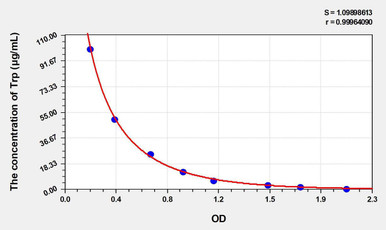
Mouse Trp (Tryptophan) ELISA Kit (AEKE03090)
Used by Zhang et al. (2026) to quantify tryptophan in the same microglial lysates.
View kit →At a glance
| Study | Model / species | Sample type | Products | What it measured | Role in study |
|---|---|---|---|---|---|
| Zhang et al., 2026, J Integr Neurosci [1] | Female C57BL/6 mice, 10–12 weeks; sham, OVX, OVX + low E2, OVX + high E2 | Lysates of Percoll-isolated, microglia-enriched hippocampal cells (n = 6, per Fig. 5 legend) | Mouse KYN ELISA Kit (MOFI01315); Mouse Trp ELISA Kit (AEKE03090) | Kynurenine and tryptophan concentrations | Metabolic evidence that OVX shifts Trp metabolism toward the kynurenine pathway, and that E2 reverses it |
Why measure tryptophan and kynurenine?
Tryptophan is an essential amino acid: a small fraction is converted by tryptophan hydroxylase (TPH2 in brain) to serotonin (5-HT), while most is degraded through the kynurenine pathway. The first, rate-limiting step of that degradation is catalysed by indoleamine 2,3-dioxygenase 1 (IDO1) or tryptophan 2,3-dioxygenase, producing kynurenine. IDO1 is induced by pro-inflammatory cytokines, so inflammation can divert tryptophan toward kynurenine and its neuroactive downstream metabolites, such as 3-hydroxykynurenine and quinolinic acid.
Measured together, a fall in tryptophan and a rise in kynurenine in the same samples is consistent with increased pathway flux; either analyte alone is harder to interpret.

How the products were used
Zhang et al. (2026): oestrogen, microglial inflammation and the tryptophan–kynurenine pathway
Research question. The authors asked whether depression-like behaviour after OVX is linked to microglial NF-κB p65 inflammation and a shift of tryptophan metabolism toward the kynurenine pathway, and whether E2 reverses these changes.
Experimental design. Adult female C57BL/6 mice underwent bilateral OVX or sham surgery. After a four-week recovery, OVX mice received corn-oil vehicle or subcutaneous E2 at 1.0 or 5.0 µg/mouse/day for four weeks. Behaviour was assessed by sucrose preference, open field, forced swim and tail suspension.
Samples. Hippocampal cells were isolated on a Percoll gradient (cells in 30% Percoll layered over a 70% cushion). The authors state that no antibody-based purification was performed, so the cells were a microglia-enriched population, typically above 80% Iba1+ by cytospin. The cells were lysed in cold PBS with a protease inhibitor cocktail and centrifuged, and the supernatant was taken for analysis.
Assay workflow as reported. Tryptophan and kynurenine were quantified in these lysates with the Assay Genie Mouse Trp ELISA Kit (AEKE03090) and Mouse KYN ELISA Kit (MOFI01315) “according to the manufacturer’s protocol” [1]. All samples were run in duplicate and read on a microplate reader. 5-HT, 5-HIAA and cytokines (TNF-α, IL-1β, IL-6) were also measured by ELISA (5-HT and 5-HIAA with other vendors' kits). Groups were compared by one-way ANOVA with Tukey's test. The paper does not describe a normalisation step (for example, to total protein) for the ELISA data, does not state concentration units in the text, and does not report a kynurenine/tryptophan ratio.

How the readout supported the conclusion. Tryptophan was significantly lower and kynurenine significantly higher in the OVX group than in controls (both p < 0.001), and E2 reversed both changes dose-dependently. The shift matched other OVX findings: higher IDO1 and MAO-A, lower TPH2, SERT and 5-HT, more iNOS+ Iba1+ microglia and nuclear phospho-NF-κB p65. The authors read this as oestrogen deficiency linking microglial inflammation to tryptophan diversion, while acknowledging a correlational design with no in vitro E2 experiments.
Practical considerations for Trp and Kyn ELISA in cell lysates
Generic best practice, not reported by the study:
- Measure both analytes in the same aliquot. Paired values allow a within-sample kynurenine/tryptophan ratio.
- Normalise lysate data. Express concentrations per mg total protein or per cell number, and report the units.
- Control pre-analytical variables. Keep samples cold, avoid repeated freeze–thaw cycles, and keep dissection-to-freezing time consistent across groups.
- Check the matrix. Run a dilution-linearity or spike-recovery test on pooled lysate first; see each product page for validated sample types and range.
- Consider orthogonal confirmation. LC-MS/MS can confirm key comparisons and add downstream metabolites.
Measuring the tryptophan–kynurenine pathway?
The same mouse kynurenine and tryptophan ELISA kits cited by Zhang et al. (2026) are available from Assay Genie, with expert technical support.
View the Mouse KYN ELISA Kit →Frequently asked questions
What does a high kynurenine-to-tryptophan ratio mean?
A raised kynurenine/tryptophan ratio means more tryptophan is being converted to kynurenine, which is usually read as increased IDO1 or TDO activity. Inflammatory cytokines such as IFN-γ and TNF-α induce IDO1, so the ratio is widely used as a marker of immune activation in depression, infection and cancer research.
Can tryptophan and kynurenine be measured by ELISA instead of LC-MS?
Yes. Competitive ELISA kits quantify each metabolite separately, so a standard plate reader is enough and many samples can be run at once. LC-MS/MS measures several pathway metabolites in one run and is often used to confirm key findings. ELISA works well for targeted comparisons between groups.
Why link the kynurenine pathway to depression?
When inflammation induces IDO1, more tryptophan goes to kynurenine and less is available for serotonin synthesis. Some downstream metabolites, such as quinolinic acid and 3-hydroxykynurenine, are neurotoxic. Together, lower serotonin and neurotoxic metabolites are proposed to contribute to inflammation-associated depression in both animal models and patients.
Why use ovariectomised mice to study depression?
Ovariectomy removes the main source of ovarian oestrogen, which models surgical or postmenopausal oestrogen loss. OVX rodents develop depression-like behaviours such as anhedonia and immobility. Giving back estradiol lets researchers test which molecular changes, such as microglial inflammation or tryptophan diversion, depend on oestrogen.
Which samples can be used for mouse kynurenine and tryptophan ELISA?
Both product pages list serum, plasma and cell lysates among the supported sample types; check each page and datasheet for the full list, sample volumes and assay range. Zhang et al. (2026) used lysates of microglia-enriched hippocampal cells, a matrix worth checking with a spike-recovery test before a full study.
References
- Zhang H, Xie Y, Yi Y, Wang C, Yuan Z, Xiao F, Jiang L. Estrogen modulates the bidirectional interplay between microglial inflammation and the tryptophan-kynurenine pathway in ovariectomy-induced depression. Journal of Integrative Neuroscience. 2026;25(11):52110. doi:10.31083/JIN52110.
Recent Posts
-
Kynurenine and Tryptophan ELISA in Microglia (Mouse OVX)
Whitepaper · Citation Application NoteKynurenine and Tryptophan ELISA in Microglia: Tracking the Trp …20th Nov 2026 -
Suspected Plague Death at a Siberian Anti-Plague Institute: What Researchers Should Know
Infectious Disease · News AnalysisSuspected Plague Death at a Siberian Anti-Plague Institute: What …6th Oct 2026 -
LPS ELISA Troubleshooting: The Importance of Sample Nature
Quick answer A researcher measuring circulating lipopolysaccharide (LPS) in human serum …25th Sep 2026